Custom TRUMPF Type Radius Forming Tool for 10 mm Thick Plate – Multi-Radius One-Step Forming
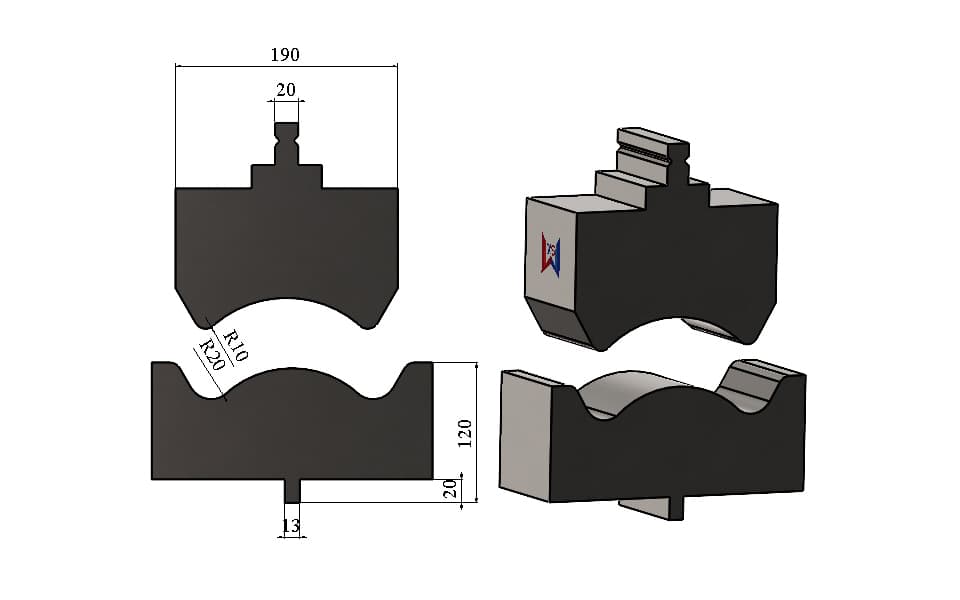
Custom TRUMPF Type radius forming tool designed for one-step forming of a 10 mm thick plate with three coordinated radii, including two side radii and one large central radius. The tooling must withstand very high forming force while accurately compensating for material springback to achieve the required final geometry. This tooling set is manufactured as a customer-specific press brake forming solution rather than a standard catalog profile. WYS Machinery provides free tooling design support based on customer workpiece drawings, material thickness, bending requirements, and press brake specifications.
Please add the quotation and send it to us and get in touch with us immediately
- Global service 24/7
- Lowest price for all products
- Best quality with Production Process
- After-Sale Warranty
- Technical Support
Description
Key Features
- Custom TRUMPF Type press brake forming tool
- Designed for 10 mm thick plate forming
- Forms three coordinated radii in one operation
- Includes two side radii and one large central radius
- One-step forming reduces repeated bending and repositioning
- Tool geometry is designed with material springback compensation
- High-strength tooling structure for large forming loads
- Matching upper and lower forming profiles
- Suitable for complex curved and profiled sheet metal parts
- Designed according to the customer's finished workpiece geometry
- Manufactured from 42CrMo alloy steel
- Heat treated for strength, wear resistance, and dimensional stability
- Press brake mounting structure can be customized
- Available in TRUMPF Type, WILA Type, LVD Type, AMADA Type, BYSTRONIC Type, and other mounting configurations
- Free press brake tooling design service available
- Tool height, width, working length, radius, and mounting interface can be customized
Technical Specifications
| Specification | Details |
|---|---|
| Tool Type | Custom Radius Forming Tool |
| Tooling System | TRUMPF Type |
| Workpiece Thickness | 10 mm |
| Forming Method | One-Step Multi-Radius Forming |
| Forming Geometry | Two Side Radii + One Large Central Radius |
| Upper Tool Width | Approx. 190 mm |
| Lower Tool Height | Approx. 120 mm |
| Central Radius | R20 |
| Side Radius | R10 |
| Material | 42CrMo Alloy Steel |
| Application | Thick Plate Radius Forming |
| Springback Compensation | Integrated into Tool Design |
| Upper & Lower Tool Set | Yes |
| Mounting Type | Customizable |
| Customization | Fully Customizable |
Complex Multi-Radius Forming in One Operation
The defining feature of this tooling set is that it forms three different curved sections in a single press brake operation.
The finished workpiece includes:
- Two side curved transitions
- One larger central radius
- Two extended side flanges
Instead of producing these geometries through several independent bending operations, the upper and lower tooling profiles are designed to form the complete section at once.
This can help reduce:
- Multiple bending steps
- Repositioning errors
- Accumulated dimensional deviation
- Operator dependency
- Cycle time for complex profiles
For parts with demanding cross-sectional geometry, a dedicated forming tool can provide much more consistent results than attempting to reproduce the same shape through multiple conventional bends.
Designed Specifically for 10 mm Thick Plate
This tooling set is used for 10 mm thick plate, which creates substantially greater forming loads than thin sheet metal.
For this type of application, the challenge is not simply producing the correct radius.
The tooling must simultaneously provide:
Sufficient Structural Strength + Accurate Forming Geometry + Stable Load Transfer
The upper and lower tool bodies therefore require substantial cross-sections to withstand the forming force without excessive deformation.
For thick-plate forming applications, the complete tooling design must consider:
- Material thickness
- Material tensile strength
- Forming length
- Required finished radii
- Press brake capacity
- Tooling strength
- Stress concentration
- Machine mounting structure
This is why complex thick-plate forming tools are normally engineered as a complete tooling system rather than selected from a standard punch and die catalog.
Springback Compensation for Accurate Final Geometry
One of the most difficult aspects of this application is material springback.
After forming pressure is released, the plate naturally tends to recover part of its original shape. For 10 mm thick material, even a relatively small springback error can create a significant deviation in the final radius and overall workpiece profile.
For this reason, the tooling geometry cannot simply reproduce the nominal finished part shape.
The design must consider:
- Material grade
- Material thickness
- Elastic recovery
- Required final radius
- Forming pressure
- Upper and lower tool interaction
Appropriate over-forming and geometry compensation can be incorporated into the tool design so that, after springback occurs, the finished workpiece approaches the required final dimensions.
TRUMPF itself describes complex special tools as being developed around the component and process, with material, shape, and machine parameters coordinated together.
Radius Forming with Matched Upper and Lower Tools
Unlike conventional air bending, this application uses a matched upper and lower forming profile.
The workpiece is progressively pressed between the two tool surfaces until the plate conforms to the required profile.
This forming method is particularly suitable for:
- Large-radius components
- Multiple-radius sections
- Thick plate profiles
- Special curved cross-sections
- Parts requiring repeatable profile geometry
TRUMPF also identifies radius forming tools as a special-tool category in which the final radius is produced through a defined relationship between the upper and lower forming tools.
High Tooling Strength for Heavy Forming Loads
Forming a 10 mm thick plate across multiple radii generates very high loads on the tooling.
The tooling structure must therefore be designed with sufficient material around the working areas to resist:
- Bending stress
- Localized compression
- Tool deflection
- Permanent deformation
- Repeated industrial loading
The large upper and lower tool bodies shown in this design are not oversized unnecessarily. Their dimensions are part of the load-bearing structure required for reliable thick-plate forming.
Actual forming force should always be evaluated according to material grade, thickness, forming length, radius geometry, and press brake capacity before production.
Custom Tooling Designed from the Finished Workpiece
This tooling was developed around the customer's required finished part, rather than around an existing standard punch profile.
This is the core principle behind WYS custom press brake tooling:
Customer Workpiece Drawing
→ Forming Process Analysis
→ Tool Geometry Design
→ Springback & Strength Evaluation
→ Tool Manufacturing
→ Finished Workpiece Forming
Customers can provide:
- 2D workpiece drawings
- 3D models
- Material grade
- Material thickness
- Required tolerances
- Press brake model
- Existing tooling system
- Production quantity
Our engineering team can then provide a free press brake tooling design proposal based on the actual bending and forming requirements.
Fully Customizable Mounting and Tool Geometry
The tooling shown here uses a TRUMPF Type mounting structure, but the forming geometry itself is not limited to this tooling system.
We can manufacture similar custom forming tools with:
- TRUMPF Type
- WILA Type
- LVD Type
- AMADA Type
- BYSTRONIC Type
- Other press brake mounting systems
Customization can include:
- Tool height
- Tool width
- Working length
- Upper and lower tool geometry
- Radius size
- Number of forming radii
- Clearance structures
- Mounting interface
- Segmented construction
- Reinforced load-bearing sections
This means the tooling shown on this page represents one custom forming solution, not the limit of our manufacturing capability.
Request a Quote
Related Products