TRUMPF Type 28° R1 Acute Angle Press Brake Upper Punch – 120 mm Height, 24 mm Width, 60 Ton/m
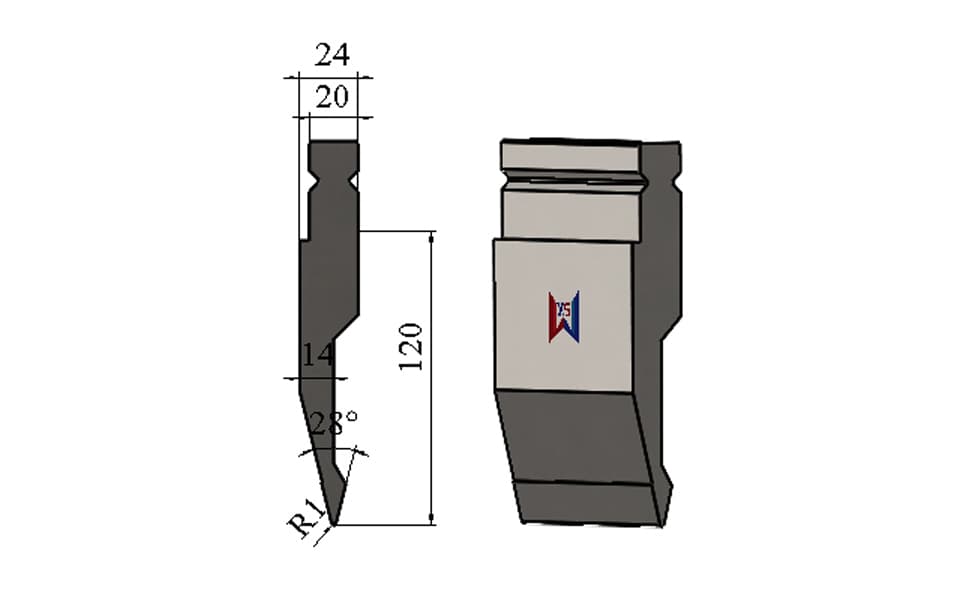
TRUMPF Type 28° R1 acute angle press brake upper punch with a 120 mm effective height, 24 mm overall width, and 60 ton/m load capacity. Its sharp 28° working angle and narrow punch profile make it suitable for acute-angle bending, pre-bending, small-angle forming, and special sheet metal applications where a standard 85°–90° punch cannot achieve the required forming geometry. Manufactured from 42CrMo alloy steel and heat treated to HRC 54 ± 2, this punch combines precision tip geometry with reliable tooling strength. WYS Machinery also provides customized TRUMPF Type tooling and free press brake tooling design service according to customer drawings and bending requirements.
Please add the quotation and send it to us and get in touch with us immediately
- Global service 24/7
- Lowest price for all products
- Best quality with Production Process
- After-Sale Warranty
- Technical Support
Description
Key Features
- TRUMPF Type acute angle upper punch for corresponding press brake tooling systems
- 28° punch angle designed for acute-angle and special forming applications
- Particularly suitable for pre-bending and small-angle bending
- 120 mm effective height provides practical working reach for industrial applications
- 24 mm overall width creates a relatively narrow and compact tooling profile
- Narrow working profile provides good accessibility around the bending area
- R1 tip radius provides a sharp and precise working geometry
- 60 ton/m load capacity for industrial sheet metal bending applications
- Suitable for applications where conventional 85°, 86°, 88°, or 90° punches cannot provide the required acute forming angle
- Suitable for precision CNC press brake bending
- Suitable for special profiles and multi-step forming
- Manufactured from 42CrMo alloy steel
- Heat treated to HRC 54 ± 2
- Precision machined for consistent punch geometry
- Standard and customized TRUMPF Type tooling available
- Free press brake tooling design service available
Technical Specifications
| Specification | Details |
|---|---|
| Tool Type | TRUMPF Type Acute Angle Press Brake Upper Punch |
| Punch Angle | 28° |
| Tip Radius | R1 |
| Effective Height | 120 mm |
| Overall Width | 24 mm |
| Load Capacity | 60 ton/m |
| Material | 42CrMo Alloy Steel |
| Hardness | HRC 54 ± 2 |
| Tooling System | TRUMPF Type |
| Application | Acute-Angle & Pre-Bending Applications |
| Tooling Type | CNC Press Brake Upper Tool |
| Customization | Available |
Typical Applications
This TRUMPF Type 28° R1 acute angle punch is designed for sheet metal applications requiring significantly smaller forming angles than conventional press brake upper tooling can provide.
Typical applications include:
- Acute-angle sheet metal bending
- Pre-bending operations
- Small-angle forming
- Sharp-angle bending
- Special profile forming
- Multi-step bending
- Hemming preparation
- Sheet metal components requiring narrow included angles
- Complex sheet metal profiles
- Machinery component fabrication
- Electrical and industrial enclosures
- Precision fabricated components
- Custom sheet metal products
- CNC press brake forming
- Special bending applications where standard-angle punches are unsuitable
The 28° acute working angle is the most important characteristic of this punch and makes it particularly useful for specialized forming processes.
For customers currently using TRUMPF original tooling or corresponding tooling systems, we can manufacture suitable TRUMPF Type tooling solutions according to existing tooling dimensions, machine specifications, and actual workpiece requirements.
28° Acute Angle for Special Bending Applications
The defining characteristic of this upper punch is its 28° acute working angle.
Compared with conventional 85°, 86°, 88°, or 90° press brake punches, the much sharper punch geometry allows the tool to perform forming operations requiring a significantly smaller included angle.
This can be particularly useful for:
- Acute-angle bending
- Pre-bending before subsequent forming
- Small-angle profiles
- Sharp bends
- Multi-stage forming processes
- Special sheet metal geometries
- Hemming preparation
- Applications requiring additional overbending
In some bending processes, the workpiece may first be formed to an acute angle and then processed in a subsequent bending or hemming operation.
The 28° punch geometry provides the additional angular range required for these specialized applications.
Actual finished bending angle depends on material properties, sheet thickness, lower die geometry, die opening, bending method, springback, and press brake settings.
Narrow 24 mm Structure for Improved Accessibility
Another important feature of this model is its relatively narrow 24 mm overall width.
The compact upper punch profile can provide improved accessibility when forming workpieces where surrounding geometry limits the available tooling space.
Compared with wider upper punches, the narrow profile can help:
- Reduce interference around the bending area
- Improve access to narrow workpiece profiles
- Provide additional space for previously formed sections
- Increase flexibility during multi-step bending
- Support specialized bending sequences
- Accommodate more complex workpiece geometries
Combined with the 120 mm effective height, the tool provides a practical balance between working reach and compact tooling geometry.
This makes the punch particularly useful for special profiles and complex forming applications where both angle capability and tooling accessibility are important.
R1 Tip Radius for Precise Acute-Angle Forming
The R1 tip radius provides a relatively sharp working profile that complements the 28° acute-angle geometry.
This combination allows the punch to create a clearly defined forming point while maintaining a controlled radius at the tool tip.
The R1 geometry can be useful for:
- Precise bending lines
- Acute-angle forming
- Small-radius applications
- Pre-bending operations
- Controlled sheet metal forming
- Special profile fabrication
The final inside radius of the workpiece is not determined solely by the R1 punch radius.
Material thickness, tensile strength, lower die opening, bending method, springback, and machine parameters must also be considered when selecting the correct tooling.
60 Ton/m Load Capacity for Industrial Applications
Despite its relatively sharp 28° working geometry and narrow 24 mm profile, this model has a rated load capacity of 60 ton/m.
This provides a practical balance between:
Acute-Angle Geometry + Narrow Tool Profile + Industrial Tooling Strength
The punch can therefore be used for a variety of industrial acute-angle forming applications within its rated working limits.
Typical factors affecting the actual allowable bending force include:
- Material type
- Sheet thickness
- Bending length
- Lower die opening
- Bending method
- Workpiece geometry
- Press brake capacity
- Complete tooling configuration
Because acute-angle tooling has a relatively sharp working section, correct calculation of the required bending force is particularly important before production.
Product Details & Manufacturing Quality
The upper punch is manufactured from 42CrMo alloy steel, providing a combination of strength, toughness, wear resistance, and durability for repeated industrial press brake operations.
The working area is heat treated to approximately HRC 54 ± 2, helping maintain dimensional stability and wear resistance during continuous production.
Precision machining is applied to the critical working surfaces to maintain the specified 28° punch geometry and R1 tip radius.
The 24 mm overall width creates a relatively compact tooling structure, while the 120 mm effective height provides practical working reach for different sheet metal applications.
The combination of:
28° Acute Angle + R1 Tip + 24 mm Narrow Profile + 60 Ton/m Capacity
makes this upper punch particularly suitable for customers requiring specialized acute-angle bending rather than conventional general-purpose bending.
Standard & Custom TRUMPF Type Press Brake Tooling
We manufacture standard TRUMPF Type press brake tooling and customized acute-angle punches for different machines, workpieces, materials, and bending requirements.
Acute-angle tooling is often closely related to the customer's final workpiece geometry and bending sequence. For this reason, correct tooling selection should consider not only the punch angle but also the lower die, material properties, required final angle, springback, and subsequent forming operations.
Customers can send us:
- 2D workpiece drawings
- 3D models
- Bending drawings
- Existing tooling drawings
- Press brake machine specifications
- Photos and dimensions of existing tooling
- Workpiece samples
Our engineering team provides a free press brake tooling design service to help customers determine an appropriate punch and die combination.
Customization options include:
- Punch angle
- Tip radius
- Overall tooling height
- Overall tooling width
- Working section dimensions
- Tooling length
- Segmented tooling lengths
- Special working profiles
- Clearance structures
- Interference-avoidance structures
- Machine-specific mounting dimensions
- Customized upper and lower tooling sets
For special acute-angle applications, we can evaluate required bending angle, material springback, workpiece geometry, bending sequence, tooling interference, required bending force, and machine configuration before manufacturing.
This enables us to develop a custom TRUMPF Type acute-angle tooling solution based on the customer's actual workpiece and bending process.
TRUMPF Type Acute Angle Tooling Solutions
This 28° R1 TRUMPF Type upper punch is designed for applications where conventional general-purpose press brake punches cannot provide the required forming angle.
Its sharp 28° geometry provides greater flexibility for acute-angle bending, pre-bending, and specialized forming, while the 24 mm narrow structure provides good accessibility around the workpiece.
For customers currently using TRUMPF original tooling or requiring corresponding tooling for their press brake systems, WYS Machinery can provide both standard TRUMPF Type tooling and application-specific customized tooling solutions.
Customers can provide their workpiece drawings and bending requirements, and our engineering team can provide free tooling design assistance to determine a suitable punch and die configuration.
Request a Quote
Related Products