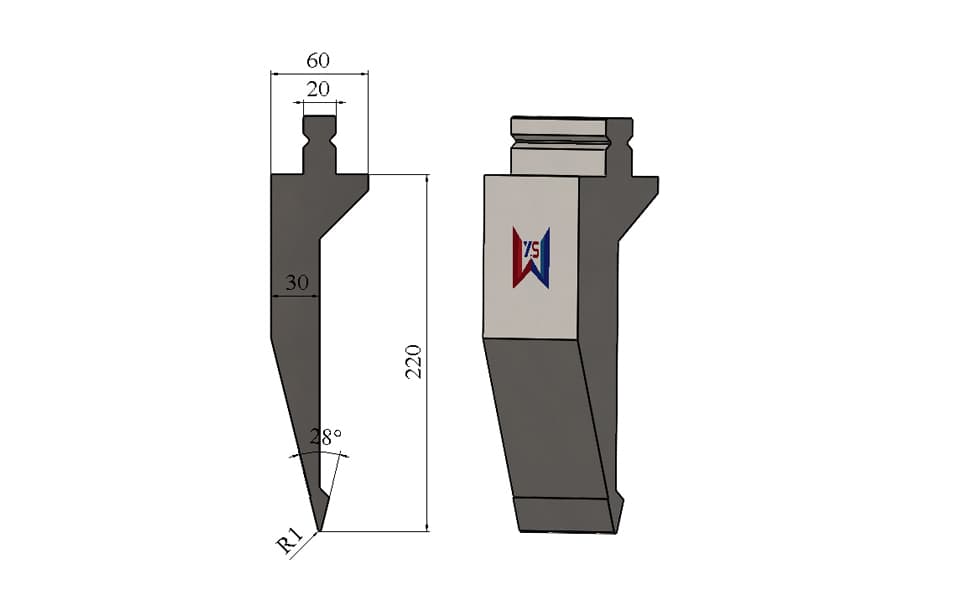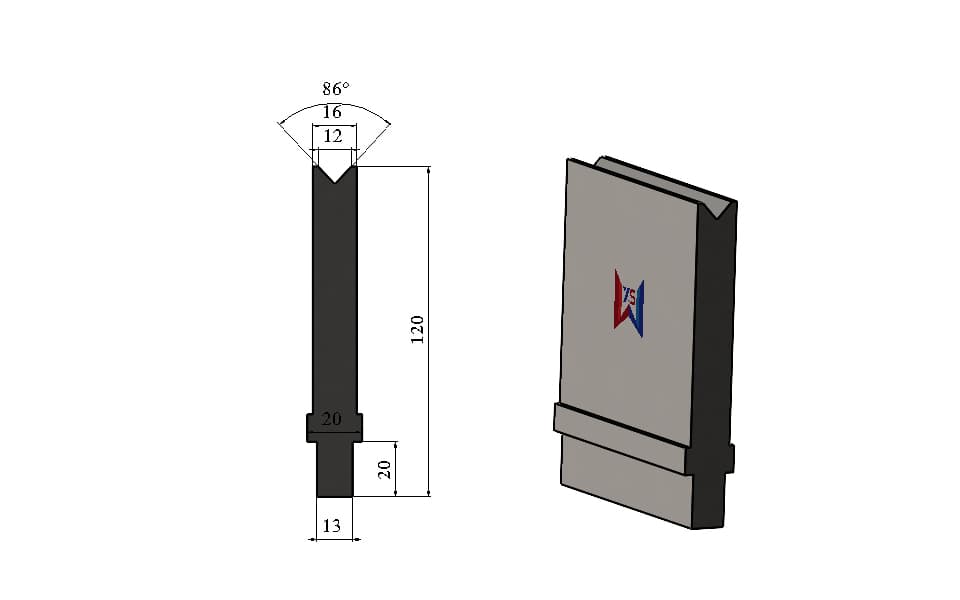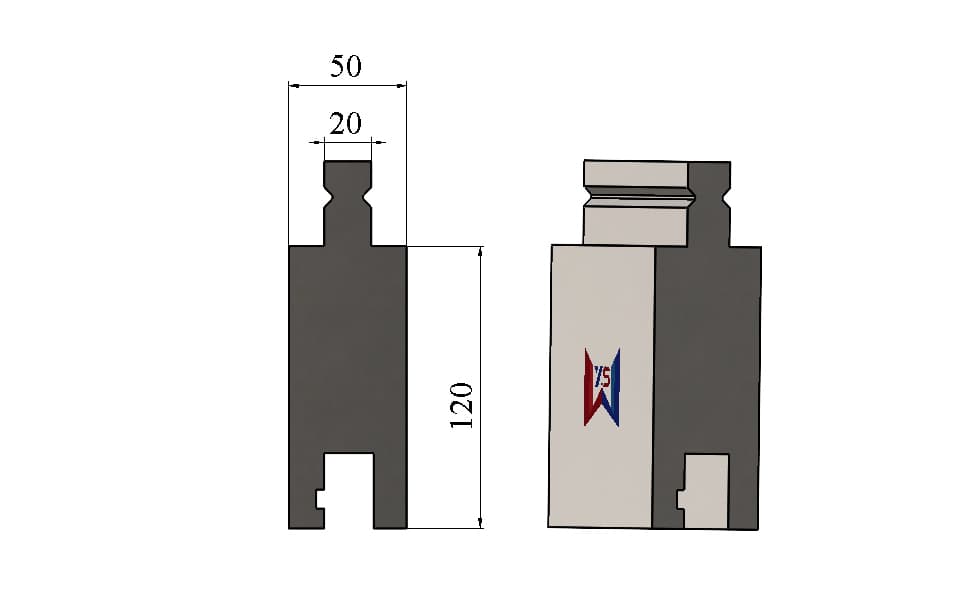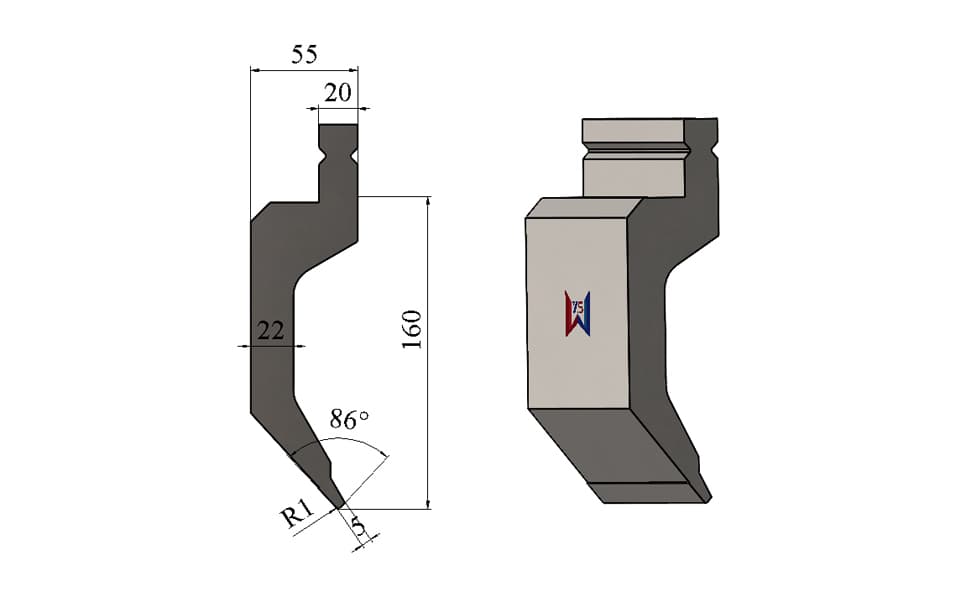
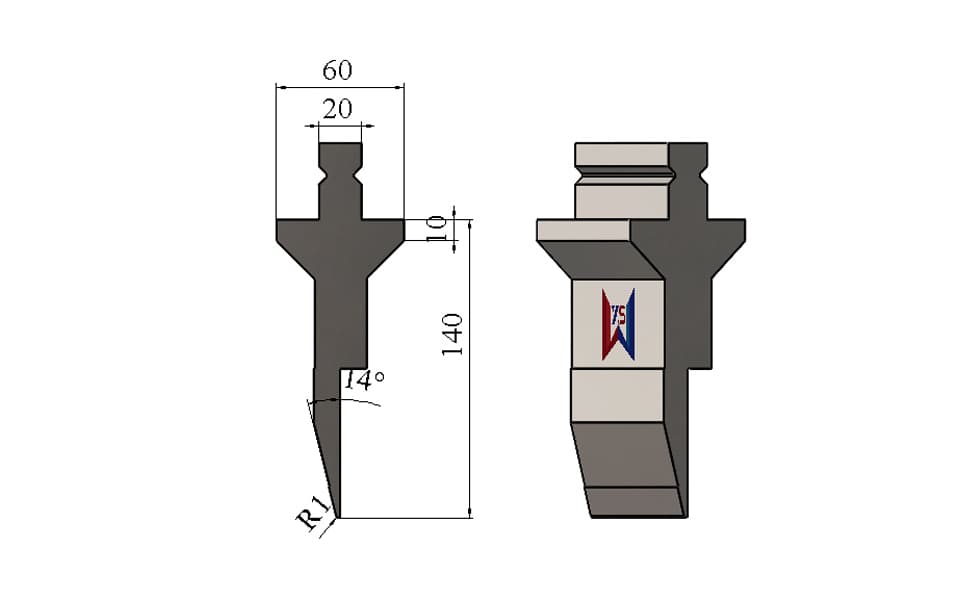
TRUMPF Type 14° R1 Hemming Punch – 140 mm Height, 60 mm Width, 40 Ton/m
TRUMPF Type 14° R1 hemming punch designed for sheet metal hemming and flattening operations. With a 140 mm effective height, 60 mm overall width, R1 tip radius, and 40 ton/m load capacity, this upper tool is typically used after the workpiece has first been pre-bent to approximately 28° or 30°, and then presses the folded edge flat to complete the hemming process. After flattening, the hemmed edge forms a double-layer section with approximately twice the original sheet thickness, providing a clean folded edge and increased local rigidity. All WYS press brake tooling can be customized according to customer workpiece drawings, material thickness, machine specifications, and bending requirements.
Please add the quotation and send it to us and get in touch with us immediately
- Global service 24/7
- Lowest price for all products
- Best quality with Production Process
- After-Sale Warranty
- Technical Support
Description
Key Features
- TRUMPF Type hemming punch designed for sheet metal flattening and hemming operations
- 14° working tip geometry designed for the hemming/flattening process
- R1 tip radius provides a controlled transition at the working area
- 140 mm effective height provides practical working reach
- 60 mm overall width creates a stable tooling structure for flattening operations
- 40 ton/m load capacity for suitable sheet metal hemming applications
- Typically used as the second step of a two-stage hemming process
- Workpiece can first be pre-bent to approximately 28° or 30°
- Hemming punch then presses the pre-bent flange into a flattened hem
- Creates a double-layer folded edge approximately twice the original sheet thickness
- Suitable for closed hems and folded-edge forming
- Helps produce clean and compact sheet metal edges
- Suitable for CNC press brake hemming applications
- Manufactured from 42CrMo alloy steel
- Heat treated to HRC 54 ± 2
- Precision machined for consistent working geometry
- All tooling dimensions and geometries can be customized
- Free press brake tooling design service available
Technical Specifications
| Specification | Details |
|---|---|
| Tool Type | TRUMPF Type Hemming Punch / Flattening Upper Tool |
| Punch Angle | 14° |
| Tip Radius | R1 |
| Effective Height | 140 mm |
| Overall Width | 60 mm |
| Load Capacity | 40 ton/m |
| Material | 42CrMo Alloy Steel |
| Hardness | HRC 54 ± 2 |
| Tooling System | TRUMPF Type |
| Main Process | Sheet Metal Hemming / Flattening |
| Pre-Bending Angle | Approx. 28° or 30° |
| Finished Structure | Double-Layer Folded Edge |
| Tooling Type | CNC Press Brake Hemming Tool |
| Customization | Fully Customizable |
Typical Applications
This TRUMPF Type 14° R1 hemming punch is specifically designed for sheet metal applications requiring a folded and flattened edge.
Typical applications include:
- Sheet metal hemming
- Flattening pre-bent sheet metal edges
- Closed hem forming
- Double-layer edge forming
- Sheet metal edge folding
- Two-stage hemming operations
- Cabinet and enclosure manufacturing
- Electrical cabinet components
- Sheet metal doors and panels
- Industrial equipment covers
- Metal furniture components
- Machinery panels
- Automotive sheet metal components
- Stainless steel fabrication
- General precision sheet metal fabrication
- CNC press brake hemming
Unlike a conventional press brake punch primarily used to create a bending angle, this tool is specifically designed to participate in the flattening stage of the hemming process.
For customers currently using TRUMPF original tooling or corresponding tooling systems, we can manufacture suitable TRUMPF Type hemming tooling according to machine specifications, existing tooling dimensions, and actual workpiece requirements.
Two-Step Sheet Metal Hemming Process
The primary application of this tool is a two-step sheet metal hemming process.
A typical hemming operation can be divided into two stages:
Step 1 – Pre-Bending
The sheet metal edge is first bent to an acute angle, typically approximately 28° or 30°, using a suitable acute-angle punch and lower die.
This creates the initial folded flange required for the subsequent flattening operation.
Step 2 – Flattening / Hemming
The pre-bent workpiece is then repositioned and the folded flange is pressed using the hemming punch.
The upper tool applies pressure to the pre-bent section until the folded edge is flattened.
The basic process can therefore be represented as:
Flat Sheet → 28°/30° Pre-Bending → Hemming / Flattening → Double-Layer Folded Edge
This two-stage process allows the press brake to produce a compact folded edge without requiring the complete hem to be formed in a single bending operation.
Double-Layer Edge After Flattening
After the hemming operation is completed, the folded portion of the sheet forms a double-layer section.
If the original sheet thickness is represented as:
T
then the nominal material stack at the completely flattened hem becomes approximately:
2T
For example, a 1.5 mm sheet will create approximately a 3.0 mm material stack at the fully folded section, before considering actual forming tolerances, bend geometry, material springback, and whether the design requires a completely closed or slightly open hem.
This type of folded edge can be useful for:
- Creating a smoother sheet metal edge
- Increasing local edge rigidity
- Eliminating an exposed sharp cut edge
- Improving component appearance
- Creating reinforced edges
- Producing compact folded structures
- Preparing specific assembly or joining geometries
The exact finished hem geometry should be determined according to the customer's workpiece design and manufacturing requirements.
14° Working Geometry for Hemming Applications
The 14° working geometry distinguishes this tool from conventional general-purpose press brake punches.
Rather than treating the 14° angle simply as an extremely acute bending punch, this model should be understood as part of a specialized hemming tooling system.
Its geometry is designed to work with a previously formed sheet metal flange during the flattening stage.
The R1 tip radius provides a controlled transition at the working area and complements the specialized punch profile.
Correct hemming results depend on the complete process, including:
- Original sheet thickness
- Material type
- Material strength
- Pre-bending angle
- Pre-bending tooling
- Hemming tooling geometry
- Required finished hem
- Press brake settings
- Applied flattening force
For this reason, the hemming punch and pre-bending tooling should ideally be considered together when developing the bending process.
40 Ton/m Load Capacity
This model has a rated maximum load capacity of 40 ton/m.
Hemming differs from conventional air bending because the final flattening stage compresses the folded material between the tooling surfaces.
The actual force required depends strongly on:
- Material type
- Material thickness
- Hemming length
- Material tensile strength
- Pre-bending angle
- Required final hem geometry
- Open or closed hem requirement
- Press brake specifications
- Tooling configuration
The 40 ton/m rating represents the tooling load limit, and the actual application should always be evaluated to ensure that both the required forming force and machine capacity remain within safe operating limits.
Product Details & Manufacturing Quality
The hemming punch is manufactured from 42CrMo alloy steel, providing strength, toughness, wear resistance, and durability for repeated industrial press brake operations.
The working area is heat treated to approximately HRC 54 ± 2, helping maintain dimensional stability and wear resistance during continuous production.
Precision machining is applied to critical working surfaces to maintain the specified 14° geometry and R1 tip radius.
The 140 mm effective height and 60 mm overall width provide a substantial tooling structure for the flattening process.
Unlike a conventional upper punch where the primary objective is simply to produce a specified bend angle, hemming tooling must also provide a controlled working geometry for the second-stage flattening operation.
The combination of:
14° Geometry + R1 Tip + 140 mm Height + 40 Ton/m Capacity
makes this tool particularly suitable for professional sheet metal hemming and folded-edge forming applications.
Standard & Fully Customizable TRUMPF Type Hemming Tooling
We manufacture both standard TRUMPF Type press brake tooling and fully customized hemming tooling solutions.
All WYS press brake tooling can be customized according to the customer's machine, workpiece geometry, material, bending process, and production requirements.
Customers can send us:
- 2D workpiece drawings
- 3D models
- Bending drawings
- Existing tooling drawings
- Press brake machine specifications
- Material and sheet thickness information
- Required finished hem dimensions
- Photos and dimensions of existing tooling
- Workpiece samples
Our engineering team provides a free press brake tooling design service.
For hemming applications, we can evaluate not only the flattening punch but also the complete two-stage forming process, including the required pre-bending angle and corresponding tooling.
Customization options include:
- Punch angle
- Tip radius
- Effective tooling height
- Overall tooling width
- Hemming geometry
- Flattening surface
- Tooling length
- Segmented tooling lengths
- Pre-bending tooling
- Special clearance structures
- Machine-specific mounting dimensions
- Customized upper punches
- Customized lower dies
- Complete pre-bending and hemming tooling sets
Customers can simply provide the workpiece drawing, material type, sheet thickness, required hem geometry, and press brake information, and we can recommend an appropriate tooling solution.
This allows us to design the tooling according to the customer's actual hemming process, rather than requiring the workpiece to fit a standard tooling profile.
Complete TRUMPF Type Pre-Bending & Hemming Tooling Solution
For sheet metal hemming, the flattening punch is only one part of the complete process.
WYS Machinery can provide both the acute-angle tooling required for the first pre-bending operation and the hemming tooling required for the second flattening operation.
A typical solution can include:
28°/30° Pre-Bending Tooling + Hemming Punch → Complete Two-Step Hemming Process
For customers currently using TRUMPF original tooling or requiring corresponding tooling for their press brake systems, we can manufacture TRUMPF Type pre-bending and hemming tooling according to machine and workpiece requirements.
If the standard configuration does not meet the customer's requirements, the angle, radius, height, width, tooling length, hemming geometry, and mounting dimensions can all be customized.
Our engineering team can provide free tooling design assistance based on the customer's finished workpiece drawing and bending requirements.
Request a Quote
Related Products