Replaceable Insert Offset Tooling for Flexible Z-Bend Forming
February 14, 2024
Modular Offset Tooling with Replaceable Inserts
Offset bending, also known as Z-bending or joggle bending, is widely used to create a controlled height difference between two sections of a sheet metal part.
Conventional offset tooling is often manufactured as a complete punch-and-die set for a specific offset dimension. When another workpiece requires a different offset height or profile, a different tooling set may be required.
The special tooling shown in this video uses a more flexible modular design.
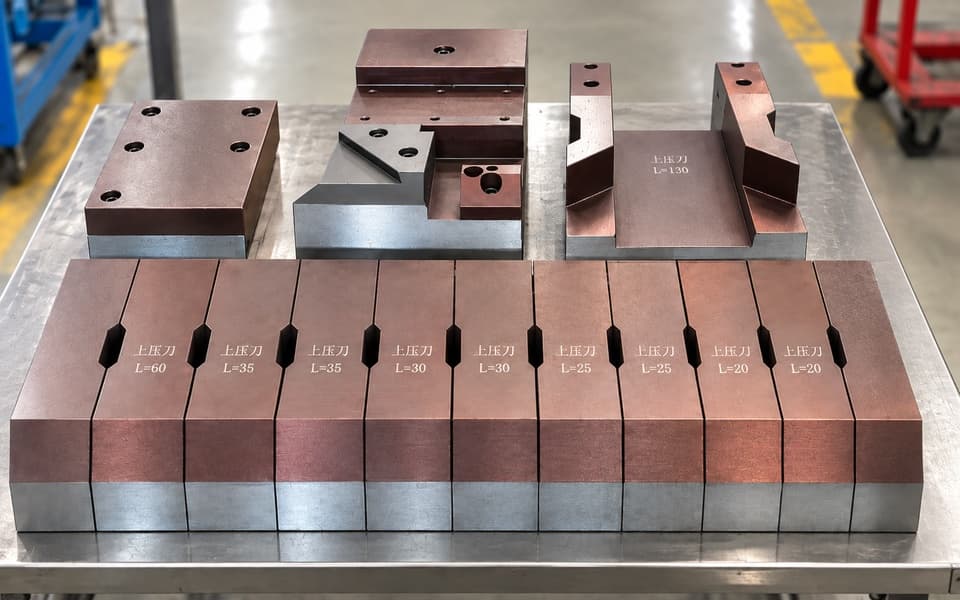
Instead of manufacturing the upper punch as one solid component, the upper tool consists of a reusable punch holder and a replaceable offset insert. Together with interchangeable matching lower dies, this structure allows the tooling configuration to be changed according to different workpiece requirements.
Reusable Punch Holder + Replaceable Offset Insert
The punch holder provides the main connection and supporting structure between the press brake and the forming insert.
The lower section—the replaceable offset insert—provides the actual forming geometry required for the offset.
When production changes to another part requiring a different offset height or profile, the complete upper punch does not necessarily need to be replaced. Instead, the appropriate upper insert and matching lower die can be installed while the main punch holder continues to be used.
This modular concept separates the reusable supporting structure from the application-specific forming geometry.
Different Offset Heights with One Tooling Platform
Different sheet metal components can require very different offset dimensions.
By preparing multiple replaceable insert and die combinations, the same basic tooling platform can be configured for different offset heights, Z-bend dimensions, material thicknesses and workpiece profiles.
This provides considerably more flexibility than a conventional fixed-size offset tool.
The concept is also established within professional press brake tooling: replaceable Z-offset inserts are used specifically so that manufacturers can expand the range of offset sizes while continuing to use existing holders.
Reducing the Cost of Special Press Brake Tooling
Cost efficiency is one of the main advantages of this design.
If every offset dimension requires an entirely new full-length punch and die set, tooling investment can increase rapidly—especially for manufacturers producing multiple sheet metal products with different Z-bend dimensions.
With a replaceable insert system, the higher-cost reusable holder can remain in service while only the forming components required for the new profile are changed.
This approach can therefore:
reduce duplicate tooling investment, expand the available range of offset sizes, simplify tooling inventory and make future tooling expansion more economical.
Replaceable-tip systems are also used elsewhere in professional press brake tooling specifically to reduce the need to repurchase an entire punch body when only the working geometry needs to change.
Forming a Z-Bend in One Press Stroke
Offset tooling is designed to create two opposing bends that produce a stepped or Z-shaped profile.
Instead of making the first bend, repositioning the sheet and then producing the second bend separately, a matched offset punch and die can form the required offset in one press brake stroke.
This can reduce repeated positioning and help maintain the relationship between the two bends.
For production parts requiring consistent offset dimensions, integrating the two bends into one forming operation can improve both efficiency and repeatability.
Precision Is Critical for Interchangeable Tooling
Replaceability also places higher demands on tooling accuracy.
The punch holder, replaceable insert and matching lower die must maintain accurate positional relationships after every changeover. The connection between the holder and insert needs sufficient rigidity to withstand forming loads while maintaining the required geometry.
Accurate machining of the mating surfaces is therefore important for achieving repeatable offset dimensions when different insert sets are installed.
A Flexible Solution for Multiple Sheet Metal Products
This modular offset tooling concept is particularly suitable for manufacturers producing multiple components with different offset requirements.
Potential applications include:
electrical enclosures, cabinets, equipment panels, metal doors, machine covers, brackets, overlapping panels and other sheet metal components requiring Z-bends, joggles or controlled height transitions.
WYS Machinery can develop custom offset tooling according to customer drawings, material thickness, required offset height, workpiece geometry and press brake configuration.
For customers producing several offset sizes, a common punch holder with multiple replaceable offset inserts and matching dies can provide a more flexible and cost-effective alternative to purchasing a completely independent tooling set for every component.