Three 90° Bends in One Stroke with Custom Press Brake Tooling
June 20, 2023
Three 90° Bends Completed in a Single Press Brake Stroke
Producing a sheet metal profile with three 90-degree bends would normally require multiple bending operations. The operator must reposition the workpiece between bends, and each additional setup can introduce dimensional and angular variation.
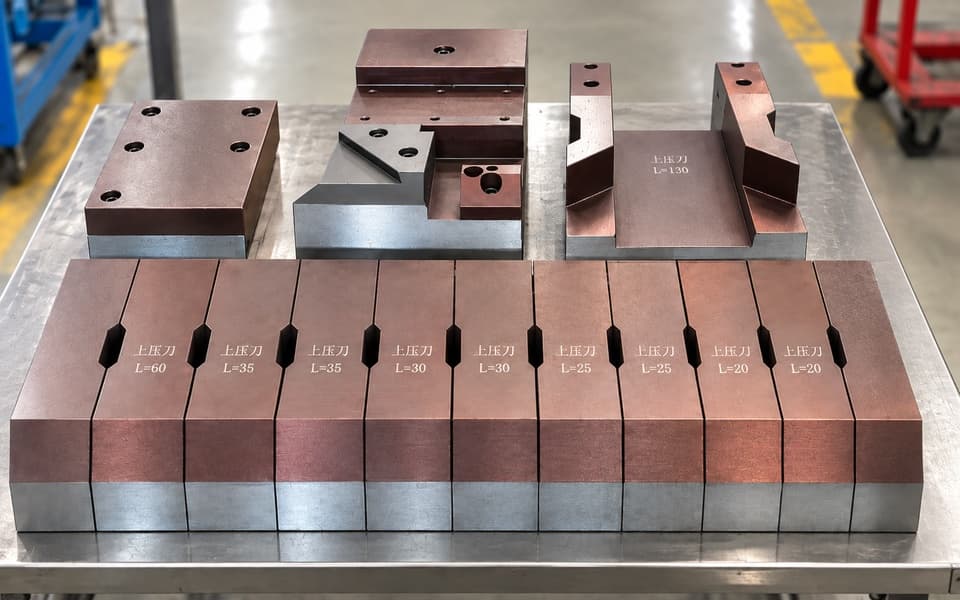
For this customer application, WYS Machinery developed a custom press brake tooling system capable of forming three 90° bends simultaneously in one press stroke.
Instead of treating the three bends as separate operations, the punch and die are engineered as an integrated forming system. As the press brake closes, different forming surfaces work together in a controlled sequence, allowing the required profile to be produced in a single forming cycle.
One Stroke, Three Bends
The key feature of this tooling is the integration of three bending actions into one operation.
During a conventional process, producing three right-angle bends may require repeated positioning and several press brake cycles. With this special tooling solution, the geometry of the punch and lower die is designed around the final workpiece profile so that all three bending areas can be formed within the same stroke.
This can substantially simplify the forming process for suitable components.
Controlling the Relationship Between Three 90° Bends
The challenge is not simply creating three individual bends. The relative position, angle and dimensions of all three bends must remain accurate after forming.
If one forming section begins too early, too late or reaches an incorrect depth, it can influence the geometry of the other sections and ultimately affect the finished profile.
For this reason, the tooling requires precise coordination between its different forming surfaces.
Punch geometry, die geometry, forming clearances, working height and final forming position must all be considered together according to the customer’s workpiece drawing.
Improved Dimensional Consistency
When several bends are produced separately, positioning errors from each operation can accumulate.
Integrating the three bends into one tooling system allows their geometric relationship to be controlled by the tooling itself rather than relying entirely on repeated manual or automated repositioning.
For suitable applications, this can improve:
bend-to-bend dimensional consistency, angular repeatability, profile accuracy and production stability.
This becomes particularly valuable when the dimensional relationship between the three bends is more important than the accuracy of any single bend considered independently.
Reducing Secondary Bending Operations
Another important advantage is production efficiency.
Completing three bends separately requires additional press brake cycles as well as workpiece handling, positioning and potentially intermediate inspection.
A three-bend one-stroke forming solution can reduce these intermediate operations. For medium- or high-volume production, reducing the number of bending cycles per component can contribute to shorter cycle times and more consistent production.
It can also reduce the operator handling required for complex profiles.
Custom Tooling Designed Around the Finished Part
This is a good example of why special press brake tooling should be developed around the workpiece and forming process, rather than simply modifying a standard punch or die.
The required tooling structure depends on factors such as:
workpiece geometry, sheet thickness, material properties, bend angles, dimensional tolerances, press brake capacity and the required production sequence.
Depending on the component, factors such as material springback, part removal after forming and interference between the workpiece and tooling may also need to be considered during the design stage.
From Multiple Operations to an Integrated Forming Solution
For complex sheet metal components, improving productivity does not always mean increasing machine speed.
Sometimes the more effective approach is to redesign the tooling so that multiple forming operations can be integrated into a single press stroke.
WYS Machinery develops custom press brake tooling based on customer drawings and actual forming requirements. For components involving multiple bends, complex profiles or difficult forming sequences, the tooling and bending process can be engineered together to achieve the required geometry while improving repeatability and production efficiency.