17-Groove Multi-V Press Brake Lower Die – V6 / V8 / V12 / V16 / V20 / V24 / V32 / V40, 120 × 120 mm, 100 Ton/m
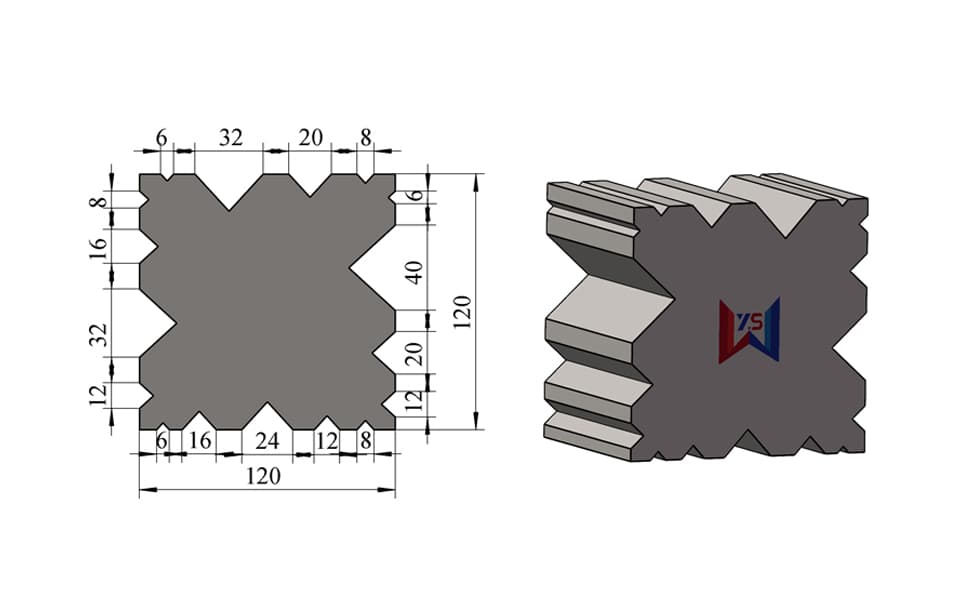
A 120 × 120 mm 17-groove multi-V press brake lower die integrating eight different V-opening sizes—V6, V8, V12, V16, V20, V24, V32 and V40—across multiple working positions. The illustrated configuration contains 17 physical V-grooves in total and has a rated load capacity of 100 ton/m. Multi-V dies with the same external dimensions can be manufactured with completely different groove quantities, opening sizes, positions and angles. Groove layout, die dimensions and mounting structures can all be customized according to the customer's bending requirements.
Please add the quotation and send it to us and get in touch with us immediately
- Global Customer Support
- Competitive Pricing
- Quality Control
- After-Sales Support
- Technical Assistance
Description
17-Groove V6 / V8 / V12 / V16 / V20 / V24 / V32 / V40 Multi-V Press Brake Lower Die
This multi-V press brake lower die integrates 17 physical working V-grooves into a 120 × 120 mm tooling body, providing eight different V-opening sizes within one lower die.
The illustrated configuration includes:
V6 · V8 · V12 · V16 · V20 · V24 · V32 · V40
with several V-opening sizes repeated at different working positions around the tooling body.
The groove distribution is:
- V6 × 3
- V8 × 3
- V12 × 3
- V16 × 2
- V20 × 2
- V24 × 1
- V32 × 2
- V40 × 1
This provides a total of 17 usable V-grooves within one lower tooling section.
With an overall cross-section of 120 × 120 mm and a rated load capacity of 100 ton/m, this high-groove-count design provides a broad range of working positions for production involving different sheet thicknesses, bend radii and workpiece requirements.
An important characteristic of multi-V tooling is that the external die dimensions do not determine one fixed groove configuration. Another 120 × 120 mm lower die can have a completely different number of grooves, different V-opening sizes, different groove locations or different groove angles.
The configuration shown here therefore represents one manufacturing example rather than a fixed catalog limitation.
WYS Machinery can customize the number of physical grooves, V-opening sizes, repeated groove quantities, groove positions, groove angles, overall dimensions, tooling length, segmentation and mounting structure according to the actual bending application.
Key Features
- 17-groove multi-V press brake lower die
- 17 physical working V-grooves
- 8 different V-opening sizes
- V6 × 3
- V8 × 3
- V12 × 3
- V16 × 2
- V20 × 2
- V24 × 1
- V32 × 2
- V40 × 1
- Overall dimensions: 120 × 120 mm
- Rated load capacity: 100 ton/m
- Multiple working faces and groove positions
- Repeated V-opening sizes at different positions
- Wide range from small to larger V-openings
- Suitable for mixed sheet-thickness production
- Reduces reliance on numerous separate single-V dies
- Custom groove quantities available
- Custom V-opening combinations available
- Custom groove positions available
- Custom groove angles available
- Custom overall dimensions available
- Custom tooling length and segmentation available
- Custom mounting structures available
Technical Specifications
| Parameter | Specification |
|---|---|
| Product Type | Multi-V Press Brake Lower Die |
| Total Number of V-Grooves | 17 |
| Different V-Opening Sizes | 8 |
| V6 Grooves | 3 |
| V8 Grooves | 3 |
| V12 Grooves | 3 |
| V16 Grooves | 2 |
| V20 Grooves | 2 |
| V24 Grooves | 1 |
| V32 Grooves | 2 |
| V40 Grooves | 1 |
| Overall Width | 120 mm |
| Overall Height | 120 mm |
| Load Capacity | 100 ton/m |
| Groove Angle | Customizable |
| Groove Position | Customizable |
| Tool Length | Standard or Customized |
| Segmentation | Available |
| V-Opening Combination | Customizable |
| Mounting Structure | Customizable |
17-Groove Multi-V Structure
The defining feature of this product is its high-density 17-groove configuration.
Instead of assigning one working groove to each V-opening size, several commonly required V-openings are repeated at different positions around the die body.
This configuration provides:
17 physical V-grooves
while using:
8 different V-opening sizes.
The repeated V6, V8, V12, V16, V20 and V32 openings demonstrate that a multi-V die can be designed around working orientation and production requirements rather than following a simple one-opening-one-groove structure.
The exact groove quantity and distribution can therefore be optimized according to the customer's machine and production range.
Eight Different V-Opening Sizes
The illustrated lower die combines:
V6 / V8 / V12 / V16 / V20 / V24 / V32 / V40
within one 120 × 120 mm body.
V6 and V8
These small openings provide narrow forming widths for thin sheet and applications requiring relatively small natural inside bend radii.
V12 and V16
These openings expand the tooling range toward general precision and sheet metal bending applications.
V20 and V24
These intermediate V-openings provide additional forming clearance and broader bending capability.
V32 and V40
The larger V-openings provide greater forming clearance and extend the tooling range toward larger bend radii and thicker sheet applications.
The appropriate V-opening should always be selected according to:
- Sheet thickness
- Material grade
- Tensile strength
- Required inside bend radius
- Bend angle
- Flange geometry
- Forming force
- Bending method
Repeated V-Grooves in One Multi-V Die
A multi-V lower die does not require every physical groove to have a different V-opening size.
Repeated grooves can be positioned at different locations when this provides a more practical working orientation or better tooling layout.
In this configuration:
V6 appears three times
V8 appears three times
V12 appears three times
V16 appears twice
V20 appears twice
V32 appears twice
while V24 and V40 each appear once.
Therefore:
17 physical V-grooves ≠ 17 different V-opening sizes.
Instead:
17 physical grooves = 8 different V-opening sizes.
This distinction is important when specifying custom multi-V tooling.
Same 120 × 120 mm Body, Different Multi-V Configurations
The external dimensions of a multi-V lower die do not determine its working groove configuration.
Different 120 × 120 mm multi-V dies can use completely different:
- Groove counts
- V-opening sizes
- Repeated groove quantities
- Groove positions
- Groove angles
- Working-face arrangements
- Shoulder geometry
- Groove-bottom geometry
For example, one 120 × 120 mm configuration can provide a smaller number of grooves with much larger V-openings, while another—such as this 17-groove version—can integrate many repeated small and medium V-openings.
The tooling should therefore be designed according to the customer's actual production range rather than external size alone.
High-Groove-Count Multi-V Design
A high-groove-count multi-V die can be useful when production requires a broad selection of working positions within one tooling body.
The 17-groove structure provides several practical benefits:
- Multiple selectable V-opening positions
- Several repeated frequently used V sizes
- Reduced number of separate lower dies
- Compact integration of many forming options
- Flexible production for different sheet thicknesses
- Simplified tooling inventory
- Custom groove layout according to the production mix
A larger number of grooves does not automatically mean that one die is better than another. The optimum configuration depends on the required V-opening range, sheet thicknesses, workpieces and machine setup.
Typical Applications
This 120 × 120 mm 17-groove multi-V lower die is suitable for:
- General sheet metal fabrication
- High-mix production
- Mixed-thickness bending
- Carbon steel bending
- Stainless steel bending
- Electrical enclosure manufacturing
- Industrial cabinet production
- Machinery and equipment fabrication
- Structural sheet metal components
- Production requiring many V-opening positions
- Workshops processing a broad range of part specifications
- Applications where reducing separate lower-die inventory improves tooling management
Custom Multi-V Press Brake Dies
WYS Machinery manufactures custom multi-V press brake lower dies according to actual production requirements.
The illustrated 120 × 120 mm, 17-groove V6 / V8 / V12 / V16 / V20 / V24 / V32 / V40 configuration represents one manufacturing example only.
Customers can customize:
number of physical V-grooves, V-opening sizes, repeated groove quantities, groove positions, individual groove angles, V-bottom geometry, shoulder geometry, working-face arrangement, overall height, overall width, load capacity, tooling length, segmentation and mounting structure.
For non-standard applications, customers can provide:
- Workpiece drawings
- Sheet thickness range
- Material grade
- Required inside radii
- Required bend angles
- Press brake model
- Existing tooling drawings
- Existing die samples
Our engineering team can evaluate the production range and develop a suitable multi-V tooling configuration.
Compatible Press Brake Tooling Systems
WYS Machinery can manufacture multi-V lower dies for different press brake tooling standards and machine configurations.
Available configurations include:
AMADA / Promecam Type, TRUMPF Type, WILA Type, LVD Type, Bystronic Type, European Type and other customized press brake tooling systems.
The 120 × 120 mm profile shown here represents one reference configuration only.
The number of grooves, V-opening sizes, groove positions, groove angles, overall dimensions and mounting interface can all be adapted to the customer's existing press brake.
WYS's current indexed lower-die content already states that customers can provide workpiece drawings, material, thickness, bend angle and machine information for tooling design, and explicitly lists Single-V, Double-V and Multi-V dies among WYS's lower-tooling capabilities.
Standard & Custom Lower Die Solutions
WYS Machinery manufactures a broad range of press brake lower tooling, including:
Single-V Dies · Double-V Dies · Multi-V Dies · Multi-Face Dies · Acute-Angle Dies · Wide-Opening Dies · High-Tonnage Dies · Special Lower Dies · Custom Press Brake Tooling
The lower die can be selected or engineered according to actual bending requirements rather than being limited to one fixed catalog profile.