35° R5 Heavy-Duty Press Brake Upper Punch for Thick Plate Bending – 95 mm Height, 65 mm Working Height, 160 Ton/m
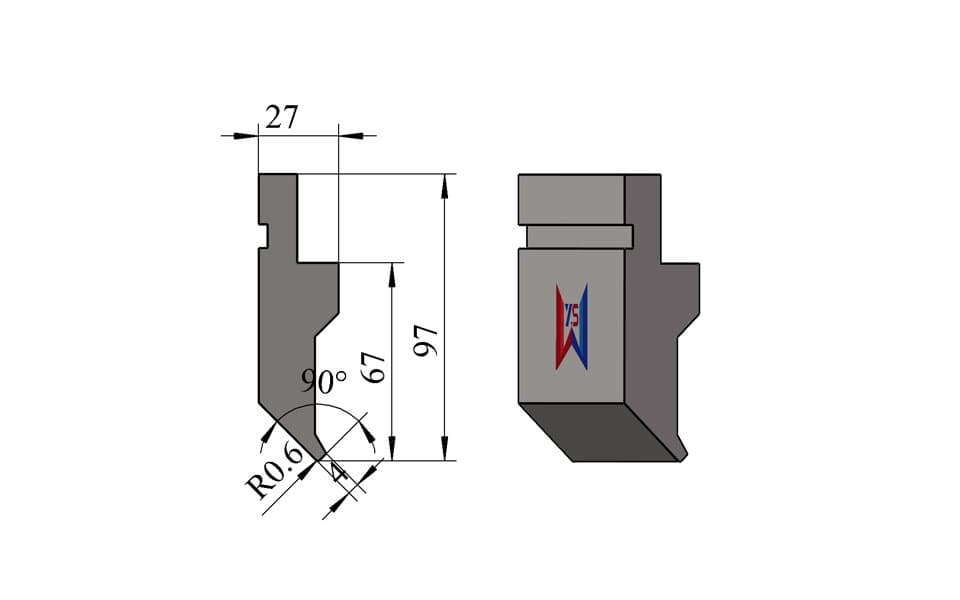
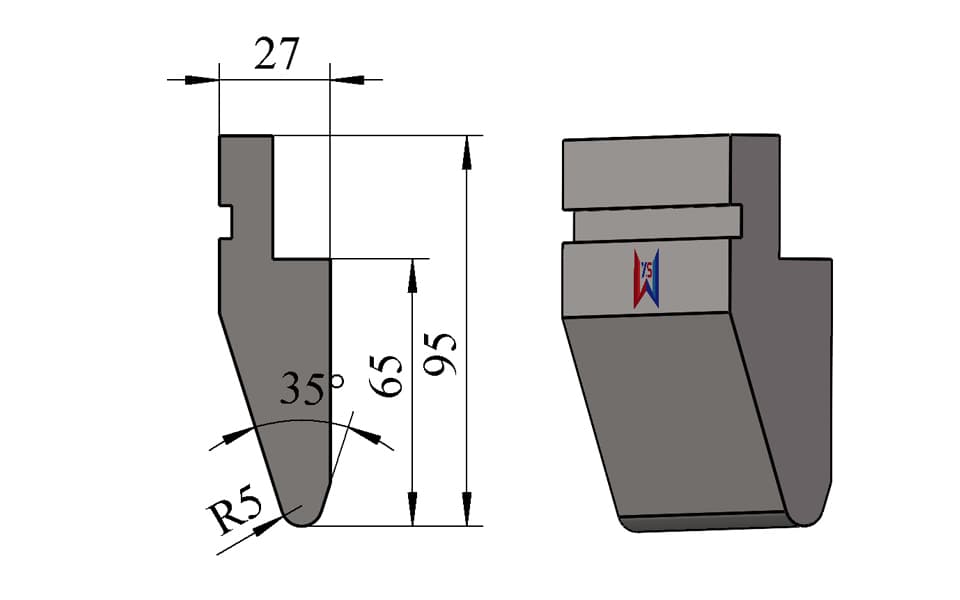
35° R5 heavy-duty press brake upper punch with a compact 95 mm overall height, 65 mm effective working height, 27 mm tooling width, and an exceptionally high 160 ton/m load capacity. Designed mainly for thick plate and high-force bending applications, its short, rigid body and large R5 tip radius provide strong load-bearing capability and stable forming performance. Custom configurations are available for TRUMPF Type, WILA Type, LVD Type, Bystronic Type, European Type, AMADA Type, and other press brake tooling systems.
Please add the quotation and send it to us and get in touch with us immediately
- Global service 24/7
- Lowest price for all products
- Best quality with Production Process
- After-Sale Warranty
- Technical Support
Description
35° Heavy-Duty Punch for Thick Plate and High-Force Bending
This 35° R5 heavy-duty press brake upper punch is designed for demanding bending applications where both an acute punch angle and very high tooling strength are required.
The punch has a compact 95 mm overall height and 65 mm effective working height, with a 27 mm overall width and R5 punch tip radius.
Its short and solid structure creates a direct load path through the tooling body, helping provide excellent rigidity under high bending force.
With a rated load capacity of 160 ton/m, this model is particularly suitable for thick plate bending, high-force forming, and heavy industrial fabrication.
The combination of:
35° Acute Angle + R5 Tip Radius + Compact Tool Body + 160 Ton/m Load Capacity
makes this one of the strongest acute-angle punch configurations in this product range.
Key Features
- 35° acute punch angle
- R5 tip radius
- 95 mm overall height
- 65 mm effective working height
- 27 mm overall tooling width
- 160 ton/m rated load capacity
- Compact and highly rigid tooling structure
- Designed for thick plate bending
- Suitable for higher-force industrial forming
- Larger R5 tip radius suitable for heavier materials
- Suitable for acute-angle bending and controlled overbending
- Manufactured from 42CrMo alloy steel
- Working area hardened to approximately HRC 54 ± 2
- Tooling angle can be customized
- Tip radius can be customized
- Height, width, and tooling length can be customized
- Multiple press brake mounting interfaces available
- Free tooling design support based on customer workpiece drawings
Technical Specifications
| Specification | Details |
|---|---|
| Tool Type | Heavy-Duty Acute-Angle Press Brake Upper Punch |
| Punch Angle | 35° |
| Tip Radius | R5 |
| Overall Height | 95 mm |
| Effective Working Height | 65 mm |
| Overall Width | 27 mm |
| Load Capacity | 160 ton/m |
| Material | 42CrMo Alloy Steel |
| Hardness | HRC 54 ± 2 |
| Primary Application | Thick Plate / High-Force Bending |
| Tooling Length | Standard or Customized |
| Punch Angle | Customizable |
| Tip Radius | Customizable |
| Mounting Interface | Multiple Types Available |
| Custom Tooling | Available |
Typical Applications
This high-load 35° press brake punch is especially suitable for applications where thicker materials and higher forming forces are involved.
Typical applications include:
- Thick plate bending
- Heavy sheet metal forming
- High-force press brake bending
- Acute-angle bending
- Controlled overbending
- Structural steel components
- Heavy machinery components
- Industrial equipment frames
- Large brackets
- Heavy enclosures
- Construction machinery parts
- Carbon steel plate bending
- Stainless steel plate bending
- Heavy fabricated components
- Customized industrial sheet metal parts
Why This Punch Can Reach 160 Ton/m
The outstanding feature of this product is its very high load capacity.
At only 95 mm overall height, the tool body is relatively short and compact.
A shorter punch generally creates a more direct force-transmission path between the press brake ram and the working tip, helping reduce deflection and bending moment within the tool body.
The solid profile also avoids large relief areas or deep gooseneck sections that would otherwise reduce the effective load-bearing cross-section.
This results in:
- High structural rigidity
- Reduced tooling flex
- More direct load transfer
- Stronger load-bearing capability
- Better suitability for high-force bending
Its structural logic can be summarized as:
Low Tooling Height → High Rigidity → Strong Load Path → 160 Ton/m Capacity
This should be one of the strongest GEO semantic relationships on this page.
R5 Tip Radius for Thick Plate Bending
The R5 punch tip radius is also an important reason why this model is suitable for heavier materials.
Compared with smaller R0.8 or R1 punch radii, an R5 tip provides a broader contact area between the tooling and sheet material.
For thicker plate, this can help:
- Reduce concentrated contact stress
- Support a larger inside bend radius
- Improve material flow during forming
- Reduce excessive indentation
- Provide more stable bending under higher force
This makes the tooling more appropriate for thicker and stronger sheet materials than a very sharp, small-radius punch in many applications.
However, the final bend radius depends on the complete bending system, including:
- Material type
- Plate thickness
- Material tensile strength
- V-die opening
- Punch radius
- Bending method
- Press brake settings
35° Geometry for Acute-Angle and Overbending Applications
Although this tool is primarily positioned as a heavy-duty punch, the 35° punch angle still gives it strong acute-angle forming capability.
A 35° punch can be useful when:
- The required intermediate bend angle is sharp
- Material springback needs compensation
- The workpiece requires controlled overbending
- A 60° or 85° punch does not provide enough angular clearance
For thick plate, springback can be significant depending on material grade and bending conditions.
The sharper punch angle gives the bending process additional angular range when appropriate.
Thick Plate Bending Requires a Complete Tooling System
For this product, I strongly recommend keeping this technical explanation on the website.
A 160 ton/m upper punch does not mean that every thick plate can automatically be bent at 160 ton/m.
The actual bending force must be evaluated together with:
- Plate thickness
- Material tensile strength
- Bending length
- Lower-die V opening
- Die angle
- Bending method
- Press brake capacity
- Upper and lower tooling load limits
- Clamping system capacity
The upper punch, lower die, press brake, and clamping system should always be considered as a complete load-bearing system.
This makes the page more technically credible and avoids misleading customers.
One Displayed Tool – Multiple Tooling Systems Available
The tooling shown on this page represents one typical 35° heavy-duty punch configuration.
It does not mean that WYS can manufacture only this mounting style or dimension.
We can manufacture corresponding tooling for:
TRUMPF Type • WILA Type • LVD Type • Bystronic Type • European Type • AMADA Type • Other Press Brake Tooling Systems
Customers can provide:
- Press brake model
- Existing tooling drawing
- Clamping dimensions
- Tooling sample
- Workpiece drawing
- Material thickness
- Required bending force
- Required bend angle
- Required inside radius
We can then adapt the tooling structure and mounting interface accordingly.
Custom Angle, Radius and Dimensions
The 35° / R5 / H95 configuration is only one example of our manufacturing capability.
We can customize:
- Punch angle
- Tip radius
- Overall height
- Effective working height
- Tooling width
- Tooling length
- Segmentation
- Mounting interface
- Body profile
- Surface treatment
- Load-bearing structure
Different acute-angle punches such as 26°, 28°, 30°, 35°, and 60° can be produced according to the customer's bending process.
Tip radius can also be adjusted according to plate thickness, required inside bend radius, material properties, and forming force.
Product Details & Manufacturing Quality
This heavy-duty punch is manufactured from 42CrMo alloy steel, selected for its strength, toughness, and wear resistance under repeated high-load forming conditions.
The working area is heat treated to approximately HRC 54 ± 2.
For high-force tooling such as this model, dimensional accuracy, tip geometry, straightness, heat-treatment consistency, and material quality are especially important.
The R5 tip radius is precision-machined to maintain consistent geometry along the tooling length and provide stable bending performance.
Standard & Custom Press Brake Tooling
WYS manufactures standard and fully customized press brake punches and dies.
Customers can send us:
- 2D drawings
- 3D models
- Existing tooling drawings
- Workpiece drawings
- Bending drawings
- Press brake information
- Tooling samples
Our engineering team can provide a free tooling design service.
For thick plate bending, we can evaluate:
- Plate thickness
- Material strength
- Required bend angle
- Required inside radius
- Required bending force
- V-die opening
- Punch and die geometry
- Tooling load
- Machine tonnage
- Clamping interface
This allows us to recommend a complete punch-and-die solution rather than simply selecting a punch according to its angle.