60° R0.8 Small Gooseneck Press Brake Upper Punch – 120 mm Height, 90 mm Working Height, 35 mm Width, 40 Ton/m
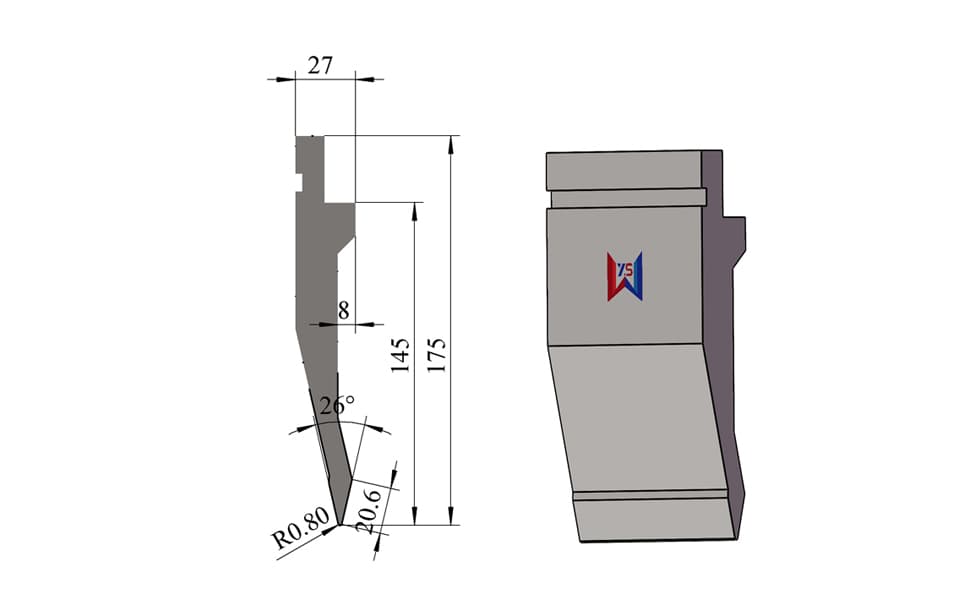
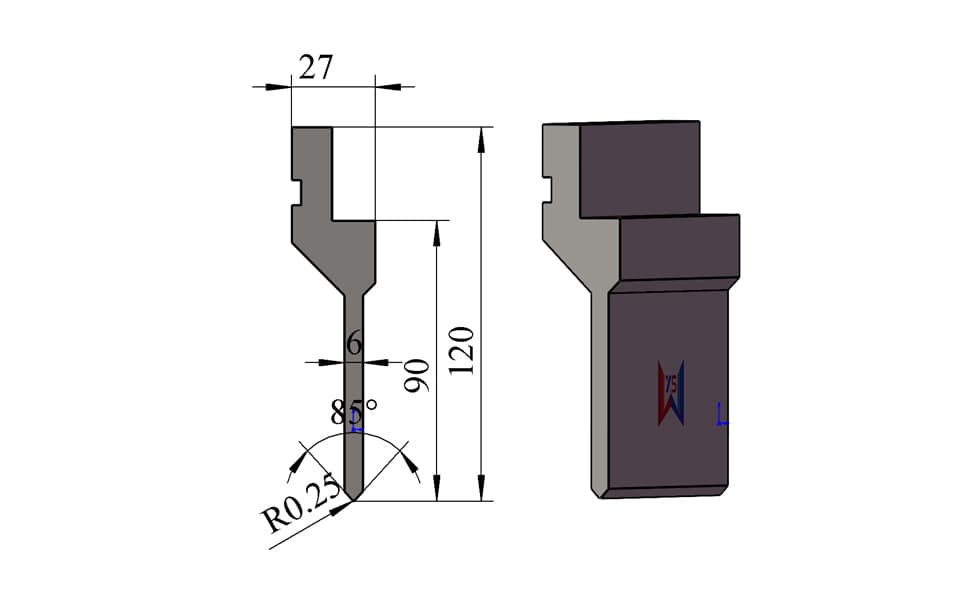
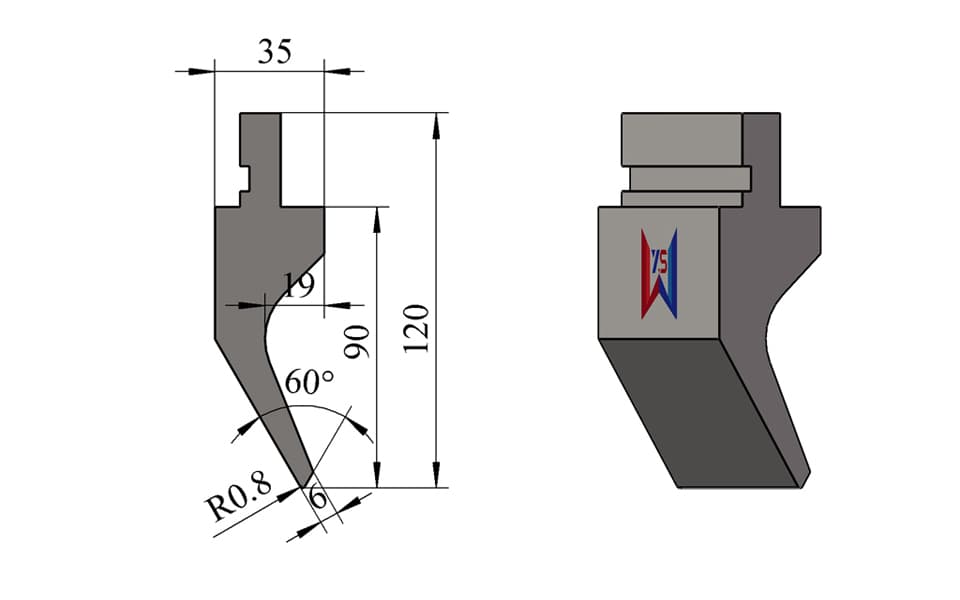
Compact 60° R0.8 small gooseneck press brake upper punch with a 120 mm overall height, 90 mm effective working height, 35 mm tooling width, 6 mm tip width, and 40 ton/m load capacity. Its compact gooseneck profile provides practical workpiece clearance for multi-step and complex bending while using less material than larger gooseneck punches. When the available clearance is already sufficient for the workpiece, this smaller design offers a more cost-effective tooling solution.
Please add the quotation and send it to us and get in touch with us immediately
- Global service 24/7
- Lowest price for all products
- Best quality with Production Process
- After-Sale Warranty
- Technical Support
Description
Small Gooseneck Punch for Practical Workpiece Clearance
This 60° R0.8 small gooseneck press brake punch is designed for sheet metal bending applications that require workpiece clearance, but do not need the large recessed profile of a full-size gooseneck punch.
The tooling has a 120 mm overall height, 90 mm effective working height, and 35 mm overall width. Its compact gooseneck geometry provides additional space around the workpiece and helps reduce interference between the punch body and previously formed flanges or walls.
With a 6 mm tip width, R0.8 tip radius, and 40 ton/m rated capacity, this model is suitable for lighter and medium-duty bending applications where clearance is important but extremely high tooling strength is not required.
The key advantage of this model is not maximum clearance.
It is:
sufficient clearance at a more economical tooling size.
Key Features
- 60° punch angle
- Compact small gooseneck profile
- Provides practical workpiece clearance
- Helps reduce punch-to-workpiece interference
- 120 mm overall height
- 90 mm effective working height
- 35 mm overall tooling width
- 6 mm tip width
- R0.8 tip radius
- 40 ton/m rated load capacity
- Suitable for small and medium-size complex workpieces
- Uses less raw material than larger gooseneck tooling
- Lower manufacturing cost compared with oversized gooseneck punches
- Suitable for multi-step and restricted-clearance bending
- Manufactured from 42CrMo alloy steel
- Working area heat treated to approximately HRC 54 ± 2
- Multiple mounting interfaces available
- Gooseneck depth and dimensions can be customized
- Free tooling design service available
Technical Specifications
| Specification | Details |
|---|---|
| Tool Type | Small Gooseneck Press Brake Upper Punch |
| Punch Angle | 60° |
| Tip Radius | R0.8 |
| Overall Height | 120 mm |
| Effective Working Height | 90 mm |
| Overall Width | 35 mm |
| Tip Width | 6 mm |
| Load Capacity | 40 ton/m |
| Clearance Type | Compact Gooseneck Clearance |
| Material | 42CrMo Alloy Steel |
| Hardness | HRC 54 ± 2 |
| Primary Application | Cost-Effective Clearance Bending |
| Tooling Length | Standard or Customized |
| Mounting Interface | Multiple Types Available |
| Custom Tooling | Available |
Typical Applications
This small gooseneck punch is suitable for applications where a certain amount of workpiece clearance is required, but the interference zone is relatively limited.
Typical applications include:
- Small box bending
- Small channel profiles
- Return flange bending
- Offset bending
- Multi-step bending
- Previously formed workpieces
- Restricted-clearance bending
- Compact sheet metal components
- Electrical enclosures
- Small machinery covers
- Brackets
- Sheet metal housings
- Customized fabricated components
Why a Small Gooseneck Can Be the Better Choice
A larger gooseneck punch does not automatically mean a better tooling solution.
The correct gooseneck size should be determined by the actual workpiece geometry.
If a customer only needs a limited amount of clearance, selecting a much larger gooseneck punch can result in:
- More raw material
- Higher tooling weight
- Higher manufacturing cost
- Higher purchase price
- Unnecessary tooling volume
If the 35 mm-wide compact gooseneck structure already provides enough clearance for the workpiece, there is little practical value in increasing the tool size.
This model therefore follows a very simple engineering principle:
Use only the clearance that the workpiece actually requires.
Its value proposition can be summarized as:
Required Clearance → Small Gooseneck Is Sufficient → Less Material → Lower Cost → Better Tooling Economy
Cost-Effective Alternative to Larger Gooseneck Punches
This is the strongest commercial difference of this product.
A larger gooseneck may provide more clearance, but that additional clearance is only useful when the workpiece actually needs it.
For many smaller components or moderate return-flange applications, a compact gooseneck can already provide enough interference protection.
In these cases, this tooling offers a more economical solution because:
- The punch body is smaller
- Less 42CrMo raw material is required
- Tooling weight is lower
- Machining volume is reduced
- Manufacturing cost can be lower
This makes it a good option for customers seeking a cost-effective custom gooseneck press brake punch.
When to Choose a Larger Gooseneck Instead
A larger gooseneck should still be selected when the workpiece has:
- Deep return flanges
- High side walls
- Large box profiles
- Large interference zones
- Deep channels
- More complex multi-step bending sequences
The goal is not to always choose the smallest tool.
The goal is to choose the smallest tooling structure that safely provides the required clearance and bending capacity.
That is where customized tooling design becomes valuable.
60° Geometry for Acute-Angle Bending
In addition to its compact gooseneck profile, the tool has a 60° working angle.
This makes it suitable for acute-angle forming and selected overbending applications where material springback needs to be considered.
The R0.8 tip radius and 6 mm tip width provide a compact forming area suitable for precision bending.
Therefore, this tooling combines:
Acute-Angle Capability + Compact Gooseneck Clearance + Cost Efficiency
One Displayed Tool – Many Tooling Systems Available
The tooling shown on this page represents one typical small gooseneck configuration.
It does not mean that WYS can manufacture only this type.
We can manufacture corresponding tooling configurations for:
TRUMPF Type • WILA Type • LVD Type • Bystronic Type • European Type • AMADA Type • Other Press Brake Tooling Systems
Customers can provide:
- Press brake model
- Existing tooling drawing
- Clamping dimensions
- Workpiece drawing
- Bending drawing
- Tooling sample
- Required clearance
- Required angle and radius
We can then adapt the punch profile and mounting interface accordingly.
Product Details & Manufacturing Quality
This small gooseneck punch is manufactured from 42CrMo alloy steel, selected for its strength, toughness, and wear resistance.
The working area is heat treated to approximately HRC 54 ± 2, helping maintain the punch profile during repeated bending operations.
The compact body minimizes unnecessary material while retaining the required workpiece clearance.
The R0.8 tip radius supports precise forming, while the 6 mm tip width creates a compact working section.
The tooling is rated at 40 ton/m.
Actual allowable bending force should be determined according to material grade, thickness, bending length, lower-die opening, bending method, and machine specifications.
Standard & Custom Gooseneck Press Brake Tooling
WYS manufactures both standard and fully customized gooseneck tooling.
Customers can send us:
- 2D workpiece drawings
- 3D models
- Existing tooling drawings
- Bending drawings
- Press brake machine information
- Tooling samples
Our engineering team can provide a free tooling design service.
For gooseneck tooling, we can evaluate:
- Required flange clearance
- Interference zone
- Workpiece movement during bending
- Required gooseneck depth
- Required tooling height
- Punch angle
- Tip radius
- Tip width
- Required tonnage
- Machine mounting interface
Customization can include:
- Punch angle
- Tip radius
- Tip width
- Overall height
- Effective working height
- Tooling width
- Gooseneck depth
- Gooseneck opening
- Relief geometry
- Tooling length
- Segmentation
- Mounting interface
- Surface treatment
Our design principle is to provide enough clearance without unnecessarily increasing tool size and cost.
Request a Quote
Related Products