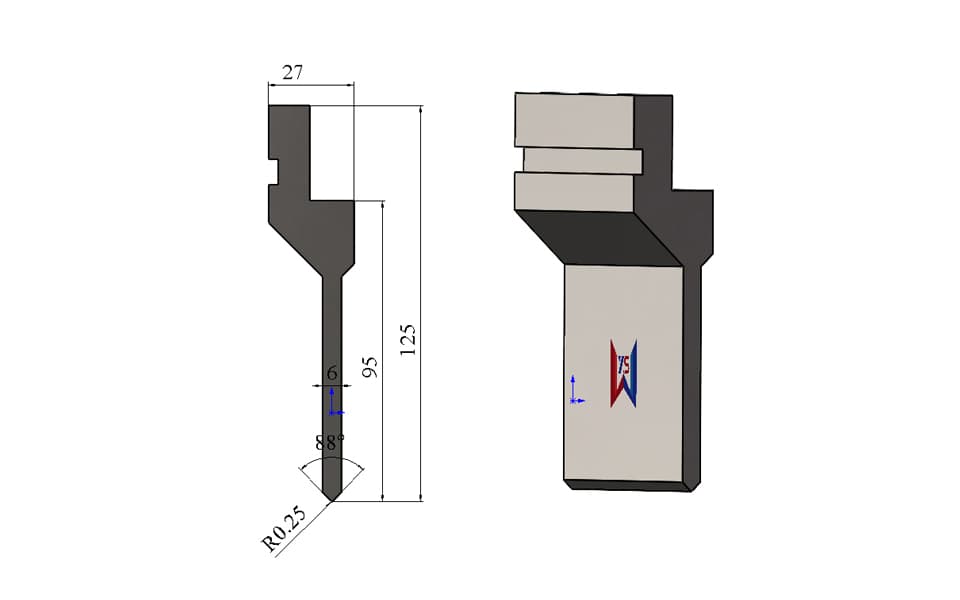
88° R0.25 Press Brake Upper Punch – 125 mm, 6 mm Load-Bearing Width
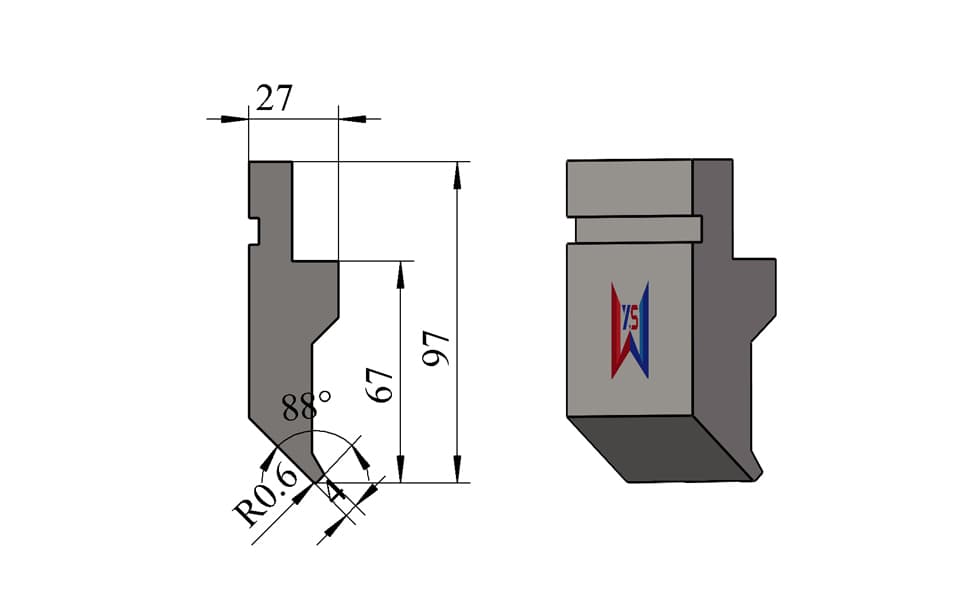
The WYS 88° R0.25 press brake upper punch is designed for precision sheet metal bending applications requiring a small tip radius. With a 125 mm overall height, 27 mm total tool width, 6 mm load-bearing width, and 50 ton/m maximum load capacity, this upper tool provides accurate and repeatable performance for compatible conventional and CNC press brake machines.
Please add the quotation and send it to us and get in touch with us immediately
- Global service 24/7
- Lowest price for all products
- Best quality with Production Process
- After-Sale Warranty
- Technical Support
Description
The WYS 88° R0.25 press brake upper punch is a precision upper tooling solution designed for sheet metal bending, forming, and industrial fabrication applications where a small punch radius and controlled contact area are required. Its 88° punch angle and R0.25 mm tip radius provide a specialized tooling geometry for precision bending operations.
Featuring a 125 mm overall height, 27 mm total tool width, and 6 mm load-bearing width, this upper punch provides a stable tooling configuration for compatible press brake machines. The extended 125 mm tool height can provide additional working clearance for specific workpiece geometries and bending applications.
With a 50 ton/m maximum load capacity, this press brake upper punch is suitable for general and precision bending applications when operated within the appropriate machine and tooling conditions. Actual allowable loading should be evaluated according to the press brake capacity, material type, sheet thickness, bending length, die opening, and specific bending application.
Key Features
- 88° punch angle for controlled sheet metal bending
- R0.25 mm tip radius for applications requiring a very small punch radius
- 125 mm overall height for additional tooling height and working clearance
- 27 mm total tool width for compatible press brake tooling systems
- 6 mm load-bearing width for a defined and controlled working contact area
- 50 ton/m maximum load capacity for general and precision bending applications
- Precision-machined working surfaces for accurate and repeatable bending
- Suitable for conventional and CNC press brake machines
- Suitable for precision sheet metal forming and industrial fabrication
- Custom press brake tooling configurations available on request
Technical Specifications
| Specification | Details |
|---|---|
| Tool Type | Press Brake Upper Tool / Punch |
| Punch Angle | 88° |
| Tip Radius | R0.25 mm |
| Overall Height | 125 mm |
| Total Tool Width | 27 mm |
| Load-Bearing Width | 6 mm |
| Maximum Load | 50 ton/m |
| Application | Sheet Metal Bending |
| Machine Type | Conventional and CNC Press Brakes |
Typical Applications
- Precision sheet metal bending for applications requiring a small punch radius
- Bending applications using mild steel and commonly processed sheet metal materials
- Stainless steel bending and general industrial metal fabrication
- Electrical cabinet, enclosure, and panel manufacturing
- Machinery components and precision sheet metal parts
- Applications requiring a very small punch tip radius
- Sheet metal forming where controlled punch-to-workpiece contact is required
- Applications benefiting from additional tooling height and working clearance
- General CNC press brake production and custom sheet metal fabrication
The appropriate upper punch and lower V-die combination should be selected according to the material type, sheet thickness, required bending angle, inside radius, bending length, machine capacity, die opening, and tooling interface.
Product Details & Manufacturing Quality
Each WYS press brake upper punch is manufactured with controlled dimensions and precision-machined working surfaces to provide reliable tooling performance, dimensional consistency, and repeatable bending accuracy.
The 88° punch geometry provides a defined working angle for sheet metal bending, while the R0.25 mm tip radius provides a very small contact radius between the upper tool and workpiece. This configuration can be suitable for applications where the bending geometry requires a fine or relatively sharp punch tip.
The 125 mm overall height and 27 mm total tool width provide the dimensional foundation of this upper tooling configuration. The increased tool height can provide additional clearance for certain workpiece geometries, although the actual available clearance depends on the complete press brake tooling setup and workpiece design.
The 6 mm load-bearing width defines the specified working contact dimension of the tool. Proper alignment and compatible lower tooling are important for maintaining stable bending performance and distributing the applied load appropriately.
With a 50 ton/m maximum load capacity, this upper punch is suitable for general and precision sheet metal bending applications when used within the specified machine and tooling capacity.
The final bending result depends on multiple factors, including material type, material thickness, tensile strength, lower die opening, bending method, machine parameters, and workpiece geometry. Proper tooling selection is therefore important for achieving the required bending accuracy and tool service life.
Standard & Custom Press Brake Tooling
In addition to standard press brake punches, WYS Machinery manufactures custom press brake tooling according to customer drawings, samples, machine specifications, or specific bending requirements.
Customized options may include different punch angles, tip radii, load-bearing widths, overall heights, tool widths, tooling lengths, shank configurations, and special tooling geometries. OEM-compatible tooling solutions can also be evaluated for specific press brake machines and tooling systems.
Whether you require a precision upper punch with a small tip radius or a customized tool for a specific forming application, WYS Machinery can provide precision press brake tooling tailored to your machine and production requirements.
Contact WYS Machinery for press brake tooling recommendations, technical support, compatibility confirmation, and a quotation.