LVD Type V120 60° Heavy-Duty Press Brake Die for 12 mm Plate
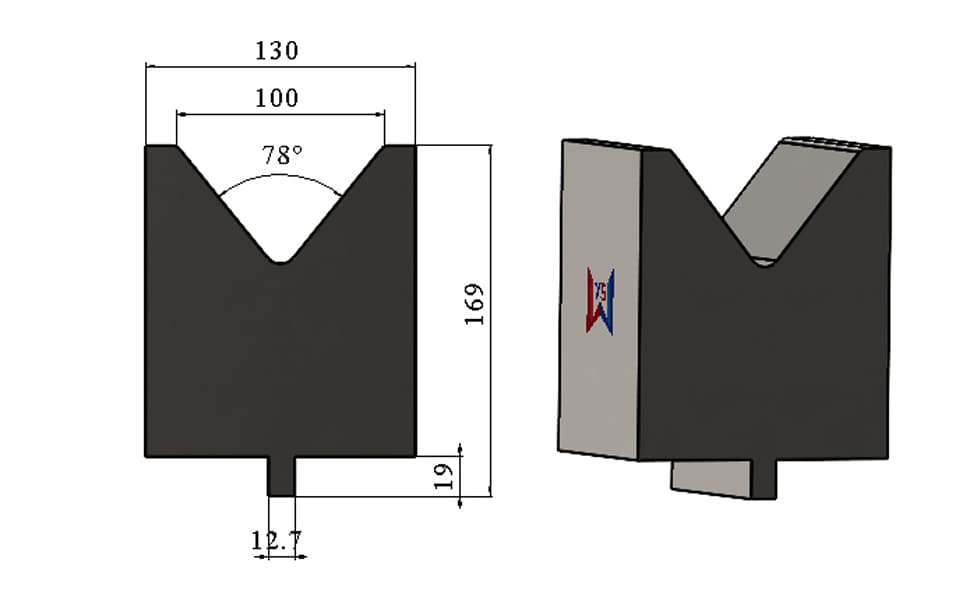
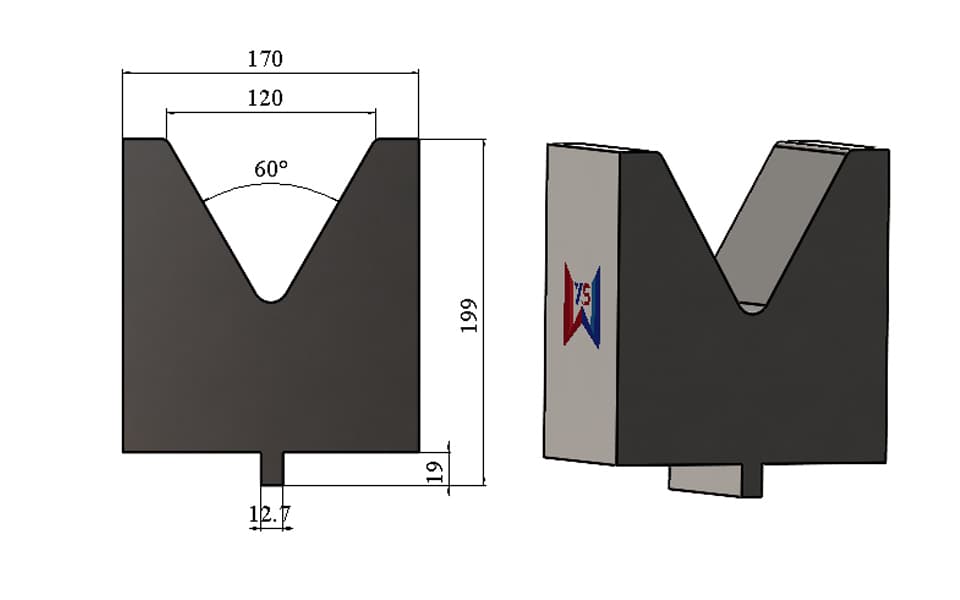
This WYS LVD-type heavy-duty single-V lower die features a 120 mm V-opening, a deep 60° groove, a 199 mm overall height and a 180 mm effective height. Its large 170 mm-wide body provides stable support and a maximum load capacity of 200 ton/m, making it suitable for air bending approximately 12 mm mild steel and other large plate components. The 60° groove also provides sufficient angular clearance for acute bending and springback compensation.
Please add the quotation and send it to us and get in touch with us immediately
- Global service 24/7
- Lowest price for all products
- Best quality with Production Process
- After-Sale Warranty
- Technical Support
Description
The WYS LVD-type V120 lower die is a large, heavy-duty press brake tool designed for thick plate, large workpieces and bending applications requiring a wide V-opening.
It features a 120 mm V-opening, commonly designated as V120, and a deep 60° V-groove. The die has an overall height of 199 mm, including a 180 mm effective working height, and an overall width of 170 mm.
For approximately 12 mm mild steel, the V120 opening provides a V-to-thickness ratio of about 10:1. This wider opening can reduce the required air-bending force compared with a narrower die, while producing a larger natural inside bend radius. The final selection must still be checked according to the material grade, tensile strength, required bend radius, flange length and available press brake capacity.
Key Features
- LVD-type heavy-duty single-V lower die
- 120 mm V-opening, commonly designated as V120
- Deep 60° V-groove
- 199 mm overall height
- 180 mm effective working height
- Large 170 mm overall tool width
- Maximum load capacity of 200 ton/m
- Generally suitable for approximately 12 mm mild steel
- Wide V-opening helps reduce thick-plate air-bending force
- Suitable for forming relatively large natural inside radii
- 60° groove permits acute bending and substantial overbending
- Helps compensate for springback in demanding materials
- Elevated working position provides additional workpiece clearance
- Large tool body provides stable structural support
- Precision-machined V-groove, shoulders and reference surfaces
- Full-length and segmented configurations available
- Optional black oxide treatment and surface coatings
- V-opening, height, width, length and mounting interface can be customized
Technical Specifications
| Item | Specification |
|---|---|
| Product Type | Heavy-duty single-V press brake lower die |
| Tooling Structure | LVD type / LVD style |
| V-Opening | 120 mm |
| Standard V Designation | V120 |
| V-Groove Angle | 60° |
| Overall Height | 199 mm |
| Effective Height | 180 mm |
| Overall Width | 170 mm |
| Lower Mounting Tang Height | 19 mm |
| Lower Mounting Tang Width | 12.7 mm |
| Maximum Load | 200 ton/m |
| Typical Plate Thickness | Approximately 12 mm mild steel |
| Material | 42CrMo alloy steel |
| Hardness | HRC54 ± 2 on applicable working areas |
| Tool Configuration | Full-length or segmented |
| Surface Treatment | Black oxide finish or optional coating |
| Primary Application | Thick-plate, large-radius and acute-angle bending |
| Customization | V-opening, angle, height, width, length, segmentation and interface |
Typical Applications
- Air bending approximately 12 mm mild steel plate
- Thick-plate and heavy sheet-metal fabrication
- Acute-angle forming using a 60° V-groove
- Bending operations requiring substantial springback compensation
- Forming large inside bend radii
- Production of heavy structural components
- Construction and agricultural machinery parts
- Large machine frames, covers and support profiles
- Heavy-duty channels and industrial enclosures
- Large workpieces requiring additional lower-tool clearance
- LVD-type CNC, hydraulic and servo-electric press brakes
The approximate 12 mm thickness recommendation is primarily based on general mild-steel air bending. Stainless steel, high-strength steel and other materials may require different tooling dimensions, larger bending forces or a modified V-opening.
V120 Opening for Approximately 12 mm Plate
A press brake V-opening is commonly selected as a multiple of the plate thickness. For 12 mm mild steel, the 120 mm opening produces a ratio of approximately 10:1.
This relatively wide opening offers several potential advantages:
- Lower air-bending force than a narrower V-opening
- Larger natural inside bend radius
- Improved suitability for thick plates
- More gradual material deformation
- Reduced concentration of forming pressure at the die shoulders
A V120 die also requires a relatively long minimum flange. Therefore, it may not be suitable for products with very short bending edges. The minimum flange, expected inside radius and required bending force should be calculated before production.
60° Deep V-Groove
The 60° V-groove provides significantly more angular clearance than a conventional 78° or 90° lower die. This makes it suitable for producing acute-angle components and for materials requiring considerable overbending.
The finished workpiece is not limited to a 60° angle. When the V120 die is matched with an appropriate upper punch and correctly programmed penetration depth, it can also be used to produce common finished angles such as 90°.
The final angle is affected by:
- Upper-punch angle and tip radius
- Punch penetration depth
- Material strength and elasticity
- Plate thickness
- Material rolling direction
- Required inside bend radius
- Actual springback
For severe acute bending, special attention should be paid to the punch tip radius, material elongation and the risk of cracking along the bend line.
Heavy-Duty 200 Ton/m Load Capacity
The die has a robust 170 mm-wide body to support the large V120 groove and transmit forming forces through the lower tooling system.
Its maximum rated load is 200 ton/m. Before bending, the calculated force must be checked against the allowable capacity of the lower die, upper punch, clamping system, tool holder and press brake.
The actual permissible load may be affected by:
- Bending length
- Plate thickness
- Material tensile strength
- Full-length or segmented configuration
- Concentrated short-length bending
- Tool condition and installation accuracy
The wider V120 opening may reduce the required bending tonnage, but all tooling and machine capacities must still be verified before production.
199 mm Overall Height for Additional Clearance
The die consists of a 180 mm effective body and a 19 mm lower mounting section, giving it an overall height of 199 mm.
This high-profile structure raises the bending line above the press brake table and provides additional clearance around the lower tool. It is useful for large workpieces, wide plates and components that already have formed flanges.
The greater working height can also assist with Z-shaped, offset and multi-step bending operations where a standard-height die may interfere with the workpiece. Actual clearance should be confirmed using the workpiece drawing and complete tooling geometry.
Product Details / Manufacturing Quality
The V120 die is manufactured from 42CrMo alloy steel to provide high strength, good toughness and resistance to deformation under heavy forming loads.
The V-groove, supporting shoulders, reference surfaces and lower mounting tang are precision-machined to maintain accurate alignment and stable force distribution. Applicable working areas can be hardened to HRC54 ± 2 to improve wear resistance and extend service life.
Quality inspection can include:
- V-opening measurement
- V-groove angle verification
- Overall and effective height inspection
- Tool width measurement
- Straightness and parallelism inspection
- Mounting-interface inspection
- Surface-hardness testing
The groove bottom uses a smooth radius transition to reduce excessive stress concentration. Its radius can be customized according to the material thickness, punch radius and required forming result.
Optional Black Oxide Finish and Surface Coating
Black oxide treatment is available to provide a uniform appearance and a degree of corrosion protection during transportation and storage.
Application-specific surface coatings can also be provided to improve wear resistance, reduce friction or minimize material adhesion during repeated production.
Available surface options include:
- Standard precision-machined finish
- Black oxide treatment
- Anti-rust surface protection
- Wear-resistant coating
- Application-specific protective coating
The appropriate treatment can be selected according to the workpiece material, production volume, operating environment and required surface quality.
Full-Length and Segmented Tooling
Because a V120 die has a large cross-section and considerable weight, a segmented configuration can make installation, handling and storage easier.
Available configurations include:
- Continuous full-length tooling
- Standard segmented sets
- Customized individual segment lengths
- Short sections for localized bending
- Left- and right-hand horn sections
- Replacement sections for specific working areas
The total length and segmentation plan can be designed according to the press brake length, lifting conditions and typical workpiece dimensions.
Standard & Custom Press Brake Tooling
WYS supplies standard and customized LVD-type punches, lower dies and complete press brake tooling systems. This V120 die can be modified according to different plate thicknesses, materials, bend radii and machine configurations.
Available customization options include:
- V-opening width
- V-groove angle
- Groove-bottom radius
- Overall and effective height
- Tool body width
- Maximum load capacity
- Overall tool length
- Individual segment lengths
- Lower mounting-interface dimensions
- Material and hardness
- Black oxide finish
- Wear-resistant and protective coatings
- Special forming profiles
Customers can send WYS their product drawings, material specifications, plate thickness, bending length and press brake information. We provide a free tooling design service to calculate the required bending force, select the appropriate V-opening and upper punch, verify minimum flange dimensions and check workpiece clearance before manufacturing.