V100 80° Stepped-Base Single-V Press Brake Lower Die – H95 × W120 mm, 100 Ton/m
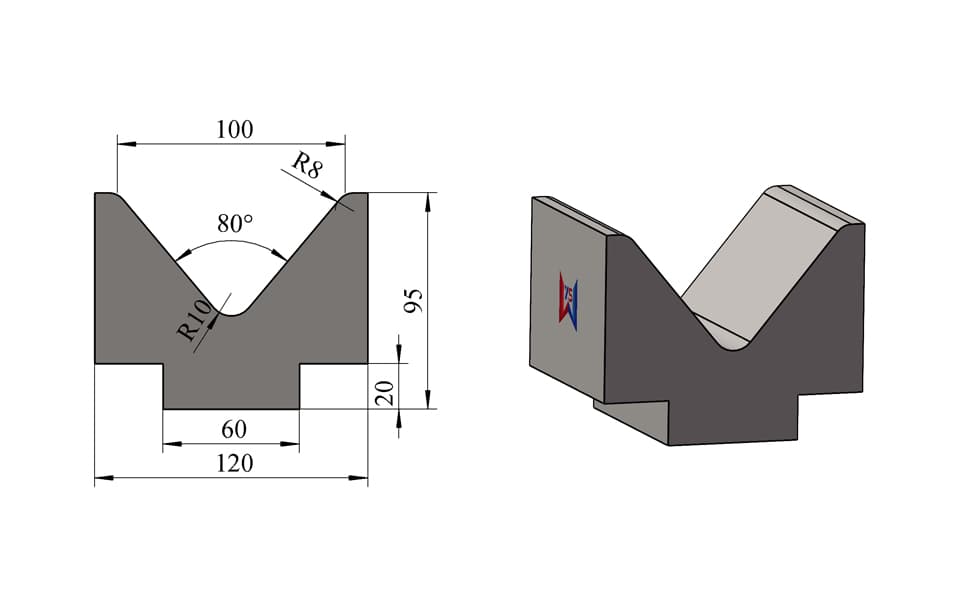
This V100 80° stepped-base single-V press brake lower die features a 100 mm V-opening, 80° die angle, 95 mm overall height and 120 mm main body width, with a 60 mm bottom base width and 20 mm stepped mounting section. The rated load capacity is 100 ton/m. Unlike conventional plug-in single-V lower dies, this model uses a stepped-base mounting structure rather than a narrow plug-in shank. The V-opening, die angle, overall height, body width, bottom base width, step geometry, groove radii, tool length and mounting interface can all be customized according to the customer's press brake and bending requirements.
Please add the quotation and send it to us and get in touch with us immediately
- Global Customer Support
- Competitive Pricing
- Quality Control
- After-Sales Support
- Technical Assistance
Description
V100 80° Stepped-Base Single-V Press Brake Lower Die
This V100 80° press brake lower die combines a large single-V working groove with a stepped lower mounting structure, providing a robust lower-tool configuration for sheet metal bending applications that require a very large V-opening and generous forming clearance.
The illustrated configuration features:
V-Opening: V100 / 100 mm
Die Angle: 80°
Overall Height: 95 mm
Main Body Width: 120 mm
Bottom Base Width: 60 mm
Stepped Section Height: 20 mm
Shoulder Radius: R8
V-Bottom Radius: R10
Rated Load Capacity: 100 ton/m
The lower mounting profile is structurally different from the narrow plug-in mounting structure used on many standard single-V lower dies. In this design, the wider 120 mm body transitions to a 60 mm stepped lower base, creating a distinct mounting geometry for compatible lower-die holders and press brake systems.
The dimensions shown represent one available configuration only. WYS Machinery can manufacture different V-openings, die angles, heights, widths, radii and mounting profiles according to customer requirements.
V100 Opening for Very Large Forming Clearance
The 100 mm V-opening provides a very large forming zone and substantial clearance around the sheet during bending.
Compared with smaller V-opening lower dies, the V100 configuration is suitable for applications requiring:
- Very large V-opening air bending
- Increased workpiece clearance
- Larger expected inside bend radii
- Broader flange and sheet geometry
- Large-section forming applications
- Additional space around the workpiece during bending
The correct V-opening should always be selected according to the material grade, sheet thickness, required inside radius, minimum flange dimension and required bending force.
80° V-Groove for Custom-Angle Air Bending
The illustrated lower die uses an 80° single-V groove.
Compared with wider-angle dies such as 85°, 88° or 90°, the 80° geometry provides additional angular clearance and can be suitable for air-bending applications where the process requires a more acute lower-die angle or additional allowance for material springback.
The final bend result depends on factors including:
- Material type
- Sheet thickness
- Punch angle
- V-opening
- Material springback
- Required inside radius
- Minimum flange dimension
- Required bending force
The illustrated 80° groove is one available configuration only. Different die angles can also be manufactured according to the customer's forming process.
Stepped-Base Mounting Structure
A key structural feature of this lower die is the stepped-base mounting profile.
The illustrated geometry includes:
Main Body Width: 120 mm
Bottom Base Width: 60 mm
Step Height: 20 mm
This differs from a plug-in lower die, which normally uses a relatively narrow bottom mounting shank beneath the main tool body.
The stepped-base design provides a broad main tool body combined with a narrower mounting section and can be adapted according to the customer's die holder, machine interface and existing tooling arrangement.
The base width, step height, body width, positioning geometry and complete die cross-section can all be customized.
R8 Shoulder Radius and R10 V-Bottom Radius
The illustrated V100 groove includes two clearly defined radius features:
Shoulder Radius: R8
V-Bottom Radius: R10
These radii form part of the working profile and can also be modified according to the V-opening, sheet thickness and required bending geometry.
Key Features
- V100 / 100 mm V-opening
- 80° single-V groove
- 95 mm overall height
- 120 mm main body width
- 60 mm bottom base width
- 20 mm stepped mounting section
- R8 shoulder radius
- R10 V-bottom radius
- 100 ton/m rated load capacity
- Stepped-base mounting structure
- Different from plug-in mounting dies
- Very large forming clearance
- Suitable for large V-opening air bending
- Custom V-opening available
- Custom die angle available
- Custom groove radii available
- Custom body and base dimensions
- Custom step geometry
- Custom tool length and segmentation
- Custom mounting interface available
Technical Specifications
| Specification | Value |
|---|---|
| Product Type | Stepped-Base Single-V Press Brake Lower Die |
| Die Structure | Single-V |
| V-Opening | V100 / 100 mm |
| Die Angle | 80° / Customized |
| Overall Height | 95 mm / Customized |
| Main Body Width | 120 mm / Customized |
| Bottom Base Width | 60 mm / Customized |
| Stepped Section Height | 20 mm / Customized |
| Shoulder Radius | R8 / Customized |
| V-Bottom Radius | R10 / Customized |
| Load Capacity | 100 ton/m |
| Mounting Structure | Stepped Base |
| Tool Length | Standard / Customized |
| Segmentation | Available |
| Mounting Interface | Stepped Base / Customized |
| Main Application | Very Large V-Opening Air Bending |
Typical Applications
This V100 80° stepped-base single-V lower die is suitable for:
- Very large V-opening sheet metal air bending
- Custom-angle forming
- Applications requiring substantial forming clearance
- Applications requiring larger inside bend radii
- Large flange bending
- Heavy and structural sheet metal forming
- Stainless steel sheet bending
- Mild steel sheet bending
- Industrial machinery components
- Structural fabrication components
- Electrical cabinet and enclosure production
- Customized press brake forming
- Tooling systems requiring a stepped lower-die base
The final tooling configuration should be selected according to the material grade, sheet thickness, required bend angle, inside radius, flange dimensions and required bending force.
Standard & Custom Options
The V100 80° stepped-base lower die shown on this page represents one available configuration only.
WYS Machinery can customize:
- V-opening
- die angle
- overall height
- main body width
- bottom base width
- stepped section height
- shoulder radius
- V-bottom radius
- edge geometry
- tool length
- segmented length
- load capacity
- bottom mounting profile
- positioning structure
- clamping interface
In addition to stepped-base single-V dies, WYS Machinery can manufacture plug-in single-V dies, full-width wide-base dies, T-type single-V dies, double-V dies, multi-V dies and other customized lower-die structures.
Compatible Press Brake Tooling Systems
WYS Machinery can manufacture lower dies for different press brake brands, tooling standards and clamping systems.
Available configurations include:
TRUMPF Type, WILA Type, LVD Type, Bystronic Type, Amada / Promecam Type, European Type and other customized press brake tooling systems.
The stepped-base structure shown here is only one available configuration.
The bottom mounting profile, base width, step height, overall height, body width and complete lower-die cross-section can all be adapted according to the customer's press brake.
Customers can provide a machine model, existing lower-die drawing, die-holder dimensions, tooling cross-section, tooling sample or workpiece drawing for technical evaluation.
Custom V-Opening and Die Angle
The V100 opening and 80° groove shown here are one available specification rather than fixed limitations.
Different V-openings and die angles can be manufactured according to:
- Material grade
- Sheet thickness
- Required bending angle
- Desired inside radius
- Minimum flange dimension
- Material springback
- Required forming clearance
- Required bending force
- Press brake configuration
This allows the lower die to be designed around the actual workpiece and machine rather than limiting the customer to one standard profile.
Custom Mounting Structure
Single-V press brake lower dies can be manufactured with different mounting structures.
WYS Machinery can provide:
Plug-in Mounting Structure
Full-Width Wide-Base Structure
Stepped-Base Structure
T-Type Structure
Other Customized Lower-Die Interfaces
The mounting geometry can be adapted according to the customer's lower-die holder and machine configuration.
Custom Press Brake Tooling Design Service
Customers can provide their workpiece drawings, material grade, sheet thickness, required bend angle, desired radius, existing tooling information and press brake model.
Our engineering team can evaluate the forming requirement and recommend a suitable lower-die configuration.
The tooling can then be manufactured with the required V-opening, angle, height, width, base geometry, groove radii, tool length and mounting structure.
Why Choose WYS Machinery
WYS Machinery manufactures standard and customized press brake punches, lower dies and sheet metal bending tooling for different forming and machine requirements.
Our lower-tooling capabilities include:
- Stepped-base single-V lower dies
- Wide-base single-V lower dies
- Plug-in single-V lower dies
- T-type single-V lower dies
- Double-V dies
- Multi-V dies
- Very large V-opening lower dies
- Custom-angle lower dies
- Customized V-openings
- Customized tool heights
- Customized base structures
- Customized groove radii
- Segmented tooling
- Special lower-tool profiles
- Custom mounting interfaces
- Replacement tooling for different press brake systems
- Tooling manufactured according to customer drawings
The products displayed on our website demonstrate available tooling structures and manufacturing capabilities, while final dimensions and mounting arrangements can be adapted to the customer's actual production requirements.