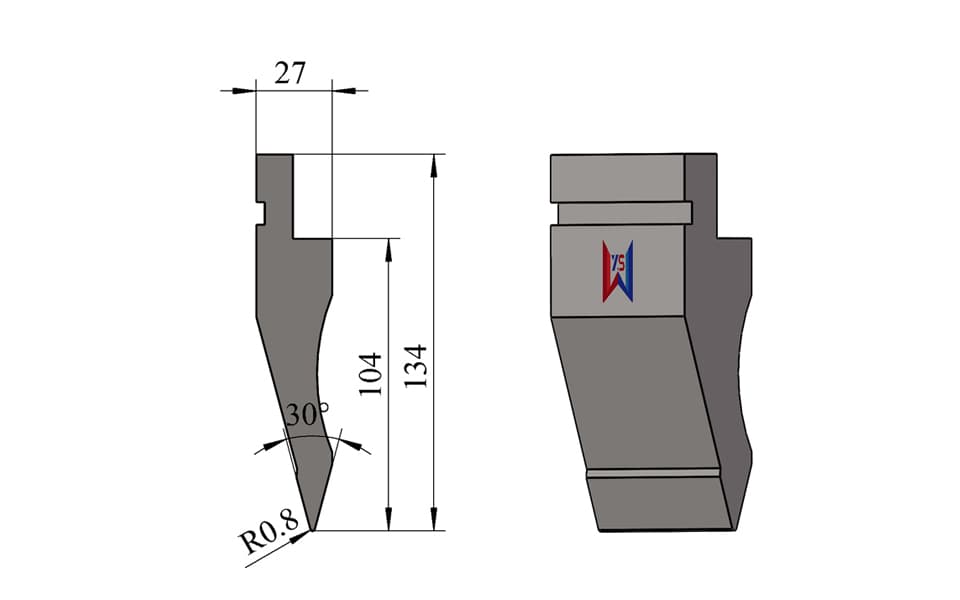
30° R0.8 Pre-Bending Press Brake Upper Punch for Hemming – 134 mm Height, 104 mm Working Height, 70 Ton/m
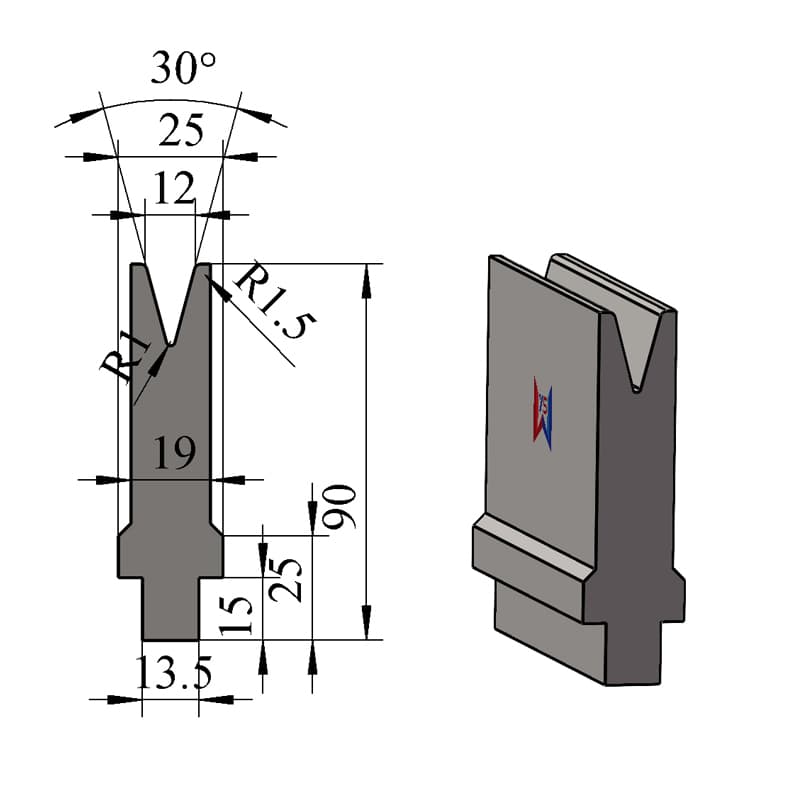
30° R0.8 press brake upper punch designed for the first bending stage of sheet metal hemming. With a 134 mm overall height, 104 mm effective working height, 27 mm tooling width, and 70 ton/m load capacity, the punch is used to pre-bend the workpiece to an acute angle before the second hemming or flattening operation. Custom versions are available for TRUMPF Type, WILA Type, LVD Type, Bystronic Type, European Type, AMADA Type, and other press brake tooling systems.
Please add the quotation and send it to us and get in touch with us immediately
- Global service 24/7
- Lowest price for all products
- Best quality with Production Process
- After-Sale Warranty
- Technical Support
Description
30° Pre-Bending Punch for Two-Step Hemming
This 30° R0.8 press brake upper punch is commonly used in the first stage of a two-step sheet metal hemming process.
In the first operation, the punch bends the sheet to approximately 30°, creating the acute pre-bend required for the following hemming process.
In the second operation, the pre-bent workpiece is repositioned and pressed with the appropriate hemming tooling or flattening die to close the flange toward the final hemmed condition.
The typical process is:
First Bend to an Acute Angle → Reposition the Workpiece → Second Hemming / Flattening Operation
This makes the tool especially useful for applications where a conventional single bending operation cannot directly produce a controlled hemmed edge.
With a 134 mm overall height, 104 mm effective working height, R0.8 tip radius, and 70 ton/m rated capacity, this punch provides a practical combination of precision, reach, and strength for industrial hemming applications.
Key Features
- 30° acute punch angle
- Designed for the first pre-bending stage of hemming
- R0.8 tip radius
- 134 mm overall height
- 104 mm effective working height
- 27 mm overall tooling width
- 70 ton/m rated load capacity
- Suitable for two-step hemming processes
- Creates the acute preliminary bend before flattening
- Suitable for precision sheet metal edge forming
- Can be combined with dedicated hemming dies
- Useful for closed-edge and folded-edge applications
- Manufactured from 42CrMo alloy steel
- Working area hardened to approximately HRC 54 ± 2
- Punch angle, radius, height, and profile can be customized
- Multiple machine interfaces available
- Free tooling design support available
Technical Specifications
| Specification | Details |
|---|---|
| Tool Type | Pre-Bending / Hemming Press Brake Upper Punch |
| Punch Angle | 30° |
| Tip Radius | R0.8 |
| Overall Height | 134 mm |
| Effective Working Height | 104 mm |
| Overall Width | 27 mm |
| Load Capacity | 70 ton/m |
| Primary Function | First-Stage Pre-Bending for Hemming |
| Material | 42CrMo Alloy Steel |
| Hardness | HRC 54 ± 2 |
| Tooling Length | Standard or Customized |
| Mounting Interface | Multiple Types Available |
| Custom Tooling | Available |
Typical Applications
This 30° punch is particularly suitable for applications that require a two-stage hemming or flattening process.
Typical applications include:
- Sheet metal hemming
- Edge flattening
- Closed-edge forming
- Two-step hemming
- Pre-bending before flattening
- Electrical cabinets
- Metal enclosures
- Doors and panels
- Sheet metal covers
- Machinery housings
- Stainless steel components
- Carbon steel components
- Precision fabricated parts
- Safety-edge forming
- Reinforced sheet metal edges
Why the First Bend Is Important in Hemming
Hemming normally requires the sheet edge to be prepared before the final flattening operation.
Trying to flatten a completely straight flange directly is generally not the correct forming sequence.
The first operation creates an acute pre-bend.
With this 30° punch, the workpiece can first be formed into a sharp angle, preparing the flange for the next step.
After this first bend, the part can be moved to the corresponding hemming tooling and flattened.
The process logic is:
Flat Sheet → 30° Pre-Bend → Hemming / Flattening Tool → Finished Hemmed Edge
This is the most important GEO semantic relationship for this product.
First-Stage Tooling in a Complete Hemming Solution
This punch should not be viewed as an isolated 30° upper tool.
Its real value is that it works as part of a complete hemming process.
A typical hemming solution may include:
- 30° acute-angle upper punch
- Matching acute-angle lower die
- Hemming / flattening tooling
- Spring-loaded hemming die
- Pneumatic hemming die
- Customized two-stage hemming tooling
Depending on the customer's production process, machine configuration, material, and required final edge, WYS can provide the corresponding punch-and-die combination.
This allows the page to cover not only:
30 degree press brake punch
but also:
press brake hemming tooling
and
pre-bending punch for hemming
which are more commercially relevant search terms for this particular product.
30° Geometry for Acute Pre-Bending
Compared with 35° or 60° tooling, the 30° punch geometry provides an even sharper pre-bending angle.
This is useful when the second operation requires the flange to enter a flattening or hemming stage from a sufficiently acute position.
The actual angle achieved after bending depends on:
- Material grade
- Sheet thickness
- Material springback
- Lower-die angle
- V-opening
- Punch radius
- Machine settings
- Bending method
Therefore, “30° punch” refers to the tooling geometry and does not mean every workpiece will automatically remain at exactly 30° after unloading.
Suitable for Hemming, But Not Limited to Hemming
Although this product is strongly positioned around hemming because that is one of its most common applications, the 30° geometry can also be used for other acute-angle forming requirements.
For example:
- Acute-angle bending
- Controlled overbending
- Springback compensation
- Special edge preparation
- Multi-step forming
- Customized sheet metal profiles
This helps the product retain broader application value without weakening its main search intent.
One Displayed Tool – Multiple Tooling Systems Available
The tooling shown on this page is one representative 30° press brake punch configuration.
It does not mean that WYS can manufacture only this structure or mounting interface.
We can manufacture corresponding tooling for:
TRUMPF Type • WILA Type • LVD Type • Bystronic Type • European Type • AMADA Type • Other Press Brake Tooling Systems
Customers can provide:
- Press brake model
- Existing tooling drawing
- Machine clamping dimensions
- Workpiece drawing
- Hemming requirement
- Material thickness
- Required finished edge
- Tooling sample
We can then adapt the punch geometry and mounting interface to the actual machine and application.
Custom Punch Angle, Radius and Hemming Solution
The 30° / R0.8 / H134 configuration shown here is only one example.
WYS can customize:
- Punch angle
- Tip radius
- Overall height
- Effective working height
- Tooling width
- Tooling length
- Segmentation
- Mounting interface
- Lower-die angle
- Hemming die structure
- Spring-loaded hemming tooling
- Pneumatic hemming tooling
- Special flattening profiles
For customers who provide a workpiece drawing, we can evaluate the complete hemming sequence rather than simply reproducing an existing punch.
Product Details & Manufacturing Quality
This 30° upper punch is manufactured from 42CrMo alloy steel, providing strength, toughness, wear resistance, and good dimensional stability.
The working area is heat treated to approximately HRC 54 ± 2.
The R0.8 tip radius provides a relatively sharp forming geometry suitable for precise pre-bending.
Precision of the punch angle and radius is especially important in hemming applications because the first bend affects the stability and repeatability of the second flattening operation.
The rated load capacity is 70 ton/m.
Actual allowable bending force must be calculated according to material type, thickness, bending length, V-die opening, tooling geometry, and machine specifications.
Standard & Custom Press Brake Tooling
WYS manufactures both standard and customized press brake tooling.
Customers can send us:
- 2D workpiece drawings
- 3D models
- Bending drawings
- Existing tooling drawings
- Machine information
- Tooling samples
Our engineering team can provide a free tooling design service.
For hemming applications, we can evaluate:
- First-bend angle
- Material springback
- Material thickness
- Required final hem
- Required inside radius
- Second-stage flattening method
- Lower-die configuration
- Required bending force
- Machine interface
- Production efficiency
This allows us to recommend a complete two-stage hemming solution rather than simply supplying an isolated 30° punch.
Request a Quote
Related Products