V20 / V40 85° Centered Two-Face Double-V Press Brake Lower Die – W50 × H50 mm, 100 Ton/m
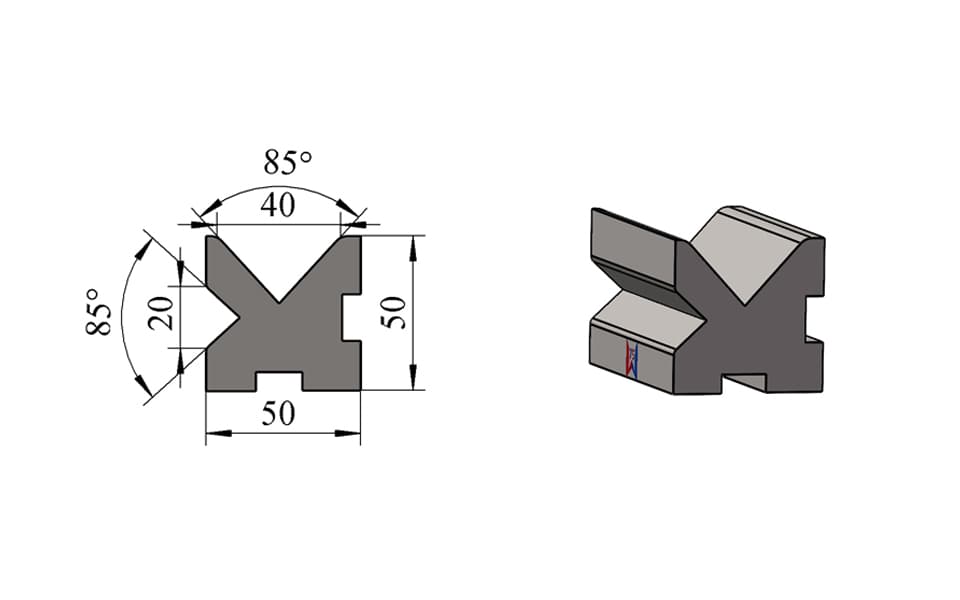
A V20 / V40 85° centered two-face double-V press brake lower die featuring two relatively large V-openings arranged on separate working faces. The active V-groove centerline is aligned with the plug-in mounting centerline, providing a centered tooling configuration during bending. Measuring W50 × H50 mm with a rated load capacity of 100 ton/m, this structure efficiently integrates V20 and V40 openings while maintaining sufficient supporting material and practical die-body rigidity. V-openings, angles, dimensions and mounting configurations can be customized.
Please add the quotation and send it to us and get in touch with us immediately
- Global Customer Support
- Competitive Pricing
- Quality Control
- After-Sales Support
- Technical Assistance
Description
V20 / V40 85° Centered Two-Face Double-V Press Brake Lower Die
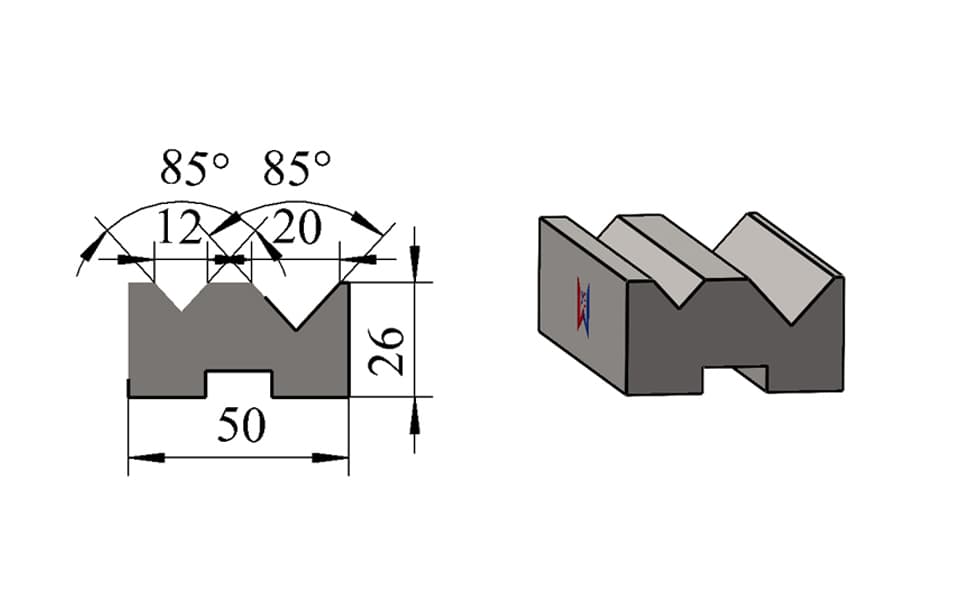
This two-face double-V press brake lower die combines V20 and V40 openings, with both working grooves manufactured at an 85° die angle.
Unlike conventional double-V dies where two V-grooves are arranged side by side on the same working surface, the V20 and V40 grooves are positioned on separate working faces of the die body.
The illustrated configuration has an overall width of 50 mm, an overall height of 50 mm, and a rated load capacity of 100 ton/m.
This structural arrangement is particularly useful when relatively large V-openings need to be integrated into a compact lower die. Larger V-grooves require sufficient shoulder width and supporting material around the working area. Positioning V20 and V40 next to each other on the same limited surface can restrict groove spacing, reduce structural support or require a substantially wider die body.
By distributing the two V-openings across separate working faces, the die can use its available cross-section more efficiently while maintaining adequate material around both grooves. This provides a practical combination of tooling flexibility, structural rigidity and efficient use of the die body.
Another important feature is the centered mounting configuration. When either V-opening is positioned in the working position, the centerline of the active V-groove is aligned with the centerline of the plug-in mounting interface.
This differs from an offset mounting configuration, where the working V-groove centerline is intentionally displaced from the mounting centerline.
The V20 / V40 structure shown here represents one available configuration rather than a fixed product limitation. V-opening combinations, groove angles, overall dimensions, working-face arrangements, mounting centerline positions and complete die geometry can all be customized according to customer requirements.
Key Features
Double-V / 2V structure: V20 and V40 working openings are integrated into one lower die body.
Separate working faces: The two V-grooves are positioned on different working faces instead of sharing the same top surface.
85° groove angles: Both the V20 and V40 openings are manufactured at 85°.
Centered mounting configuration: The active V-groove centerline aligns with the plug-in mounting centerline during operation.
Large V-opening combination: V20 and V40 provide two different forming ranges for applications requiring greater die clearance and larger natural bend radii.
Compact W50 × H50 mm body: The two-face arrangement makes more efficient use of the available tooling cross-section.
100 ton/m load capacity: Designed for demanding sheet metal bending applications within the specified tooling capacity.
Custom manufacturing available: V-opening combinations, angles, dimensions, tooling lengths, segmentation and mounting profiles can be adapted to different press brake systems.
Technical Specifications
| Parameter | Specification |
|---|---|
| Product Type | Centered Two-Face Double-V Press Brake Lower Die |
| Alternative Type | 2V Lower Die |
| V-Opening 1 | V20 / 20 mm |
| V-Opening 2 | V40 / 40 mm |
| V20 Angle | 85° |
| V40 Angle | 85° |
| V-Groove Arrangement | Separate Working Faces |
| Mounting Alignment | Centered |
| Working V / Mounting Centerline | Aligned |
| Overall Width | 50 mm |
| Overall Height | 50 mm |
| Load Capacity | 100 ton/m |
| Mounting System | Plug-in System |
| Tool Length | Standard or Customized |
| Segmentation | Available |
| V-Opening Combination | Customizable |
| Die Angle | Customizable |
| Mounting Configuration | Customizable |
Two-Face Double-V Structure
The V20 and V40 grooves are arranged on different working faces instead of being positioned next to each other on the same plane.
This configuration is particularly useful when V-openings become relatively large and require additional shoulder space and die-body support.
A same-face arrangement with two large V-openings can require a wider lower die or reduce the amount of supporting material between and around the working grooves. Separating the V20 and V40 openings across different faces allows the available tooling cross-section to be used more efficiently.
The result is a compact double-V structure capable of providing two large forming openings while maintaining practical support around each working groove.
Centered Mounting Configuration
The illustrated tooling uses a centered mounting configuration.
When the selected V-opening is placed in the active bending position:
the centerline of the working V-groove is aligned with the centerline of the plug-in mounting interface.
This centerline relationship distinguishes the tooling from an offset lower die, where the active V-groove is intentionally positioned away from the mounting centerline.
Centered and offset structures can both be manufactured depending on the press brake table, lower die holder, tooling system and application requirements.
V20 and V40 Working Openings
The V20 opening provides a relatively large forming width compared with smaller V-grooves and can be used where additional workpiece clearance or a larger natural inside bend radius is required.
The larger V40 opening provides substantially more forming clearance and is suitable for applications involving thicker material, larger bend radii and lower forming force than a smaller V-opening under otherwise comparable bending conditions.
Having V20 and V40 within the same two-face lower die provides two useful forming ranges without requiring two completely separate tooling bodies.
The final V-opening should always be selected according to the sheet thickness, material grade, tensile strength, required inside bend radius, flange geometry, bend angle and bending method.
Typical Applications
This V20 / V40 centered two-face double-V lower die is suitable for general sheet metal bending, medium and thicker sheet fabrication, carbon steel and stainless steel bending, machinery manufacturing, industrial enclosures, electrical cabinets, structural sheet metal components, mixed-thickness production and applications requiring two relatively large V-opening ranges.
The larger V40 groove is particularly useful where greater forming clearance or a larger natural inside bend radius is required.
Why Use Separate Working Faces?
When two smaller V-openings are combined, they can often be placed next to each other on one working surface.
As V-openings become larger, however, the required shoulder width and supporting material also increase. With a V20 / V40 combination, placing both grooves on the same limited surface may result in insufficient spacing, reduced shoulder material or an unnecessarily wide die body.
A two-face double-V structure provides another solution.
By distributing V20 and V40 across separate working faces, the tooling maintains sufficient material around the grooves while making more efficient use of the available die cross-section.
Plug-In Lower Die Mounting System
The illustrated lower die uses a plug-in mounting system.
The bottom mounting profile engages with the corresponding lower die holder or press brake table interface to provide positioning and support during bending.
When the other V-opening is required, the tooling can be repositioned so that the selected groove becomes the active working surface.
The plug-in configuration shown here is only one reference design. The mounting profile, centerline relationship, overall cross-section and positioning structure can all be customized according to the customer's press brake.
Custom Double-V Press Brake Dies
WYS Machinery manufactures standard and customized double-V press brake lower dies, including conventional same-face, two-face, centered and offset configurations.
The V20 / V40 tooling shown here is one design example rather than a fixed manufacturing limitation.
Customization can include V-opening combination, V-groove angle, overall height, overall width, working-face arrangement, shoulder geometry, die-body cross-section, load capacity, mounting centerline position, tool length, segmented length and bottom mounting profile.
For special bending applications, customers can provide workpiece drawings, material specifications, sheet thickness, required bending angle, V-opening requirements, existing tooling drawings or samples, and press brake information. Our engineering team can then evaluate the application and recommend a suitable lower die structure.
Compatible Press Brake Tooling Systems
WYS Machinery manufactures lower dies for different press brake tooling standards and machine configurations.
Available configurations include:
AMADA / Promecam Type, TRUMPF Type, WILA Type, LVD Type, Bystronic Type, European Type and other customized press brake tooling systems.
The plug-in and centered structure shown on this page represents one reference design only.
The V-opening, groove angle, height, width, working-face arrangement, mounting profile and centerline relationship can all be customized according to the customer's existing press brake and tooling interface.
Standard & Custom Lower Die Solutions
WYS Machinery manufactures a broad range of press brake lower tooling, including Single-V Dies, Double-V Dies, Two-Face Double-V Dies, Centered Double-V Dies, Offset Double-V Dies, Multi-V Dies, Acute-Angle Dies, Wide-Opening Dies, High-Tonnage Dies, Special Lower Dies and Custom Press Brake Tooling.
The lower die structure can be selected or engineered according to the actual bending requirement rather than being limited to a fixed catalog profile.