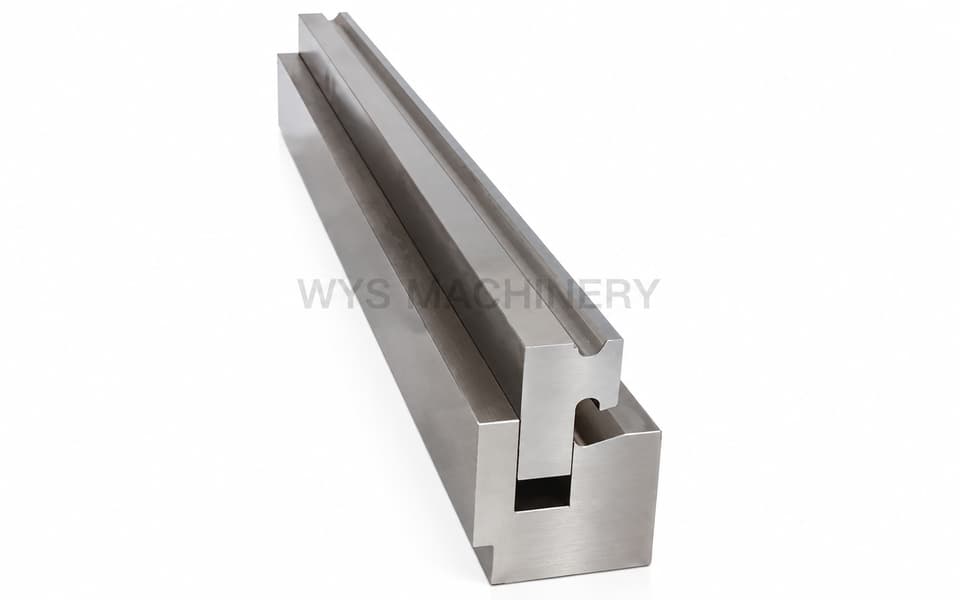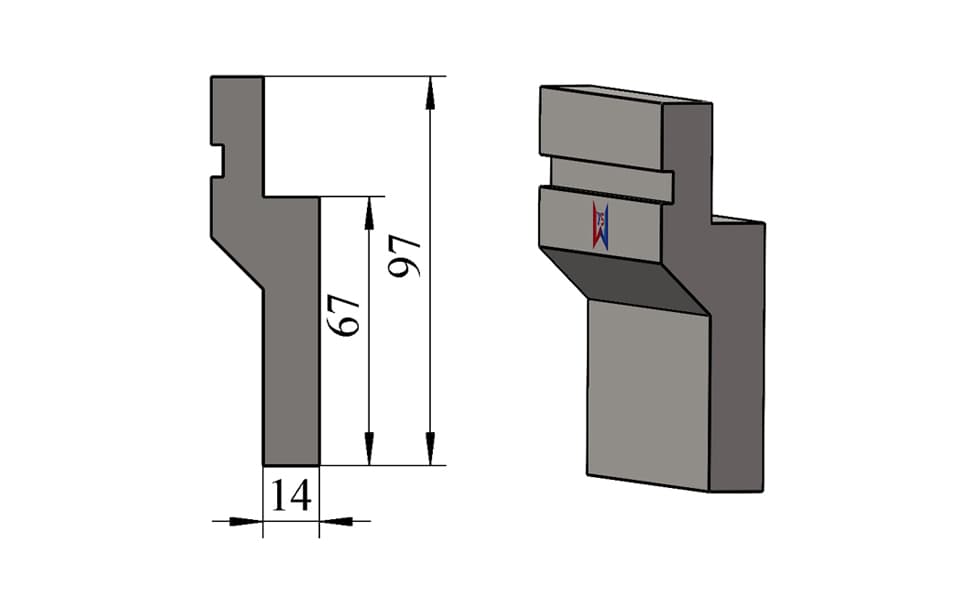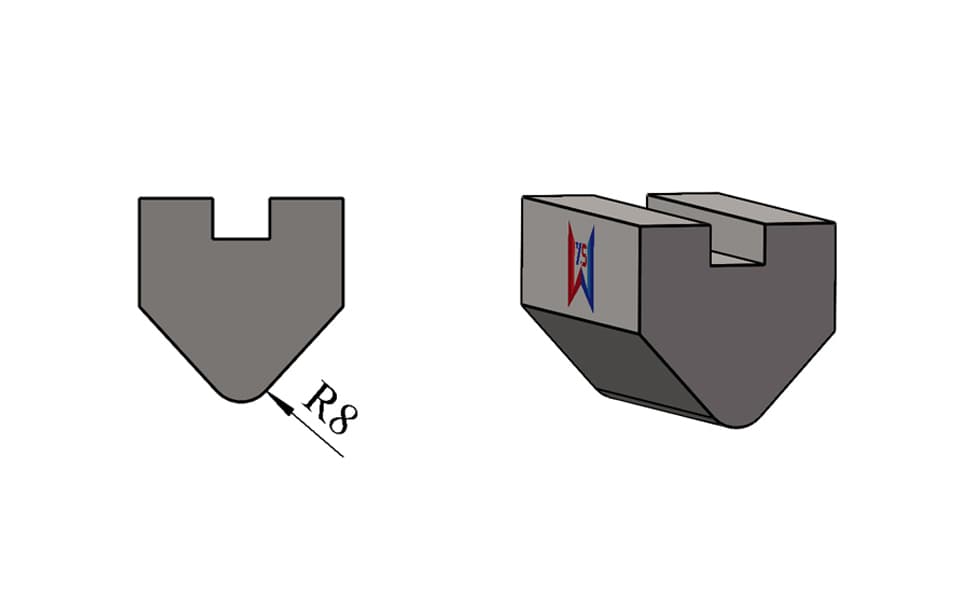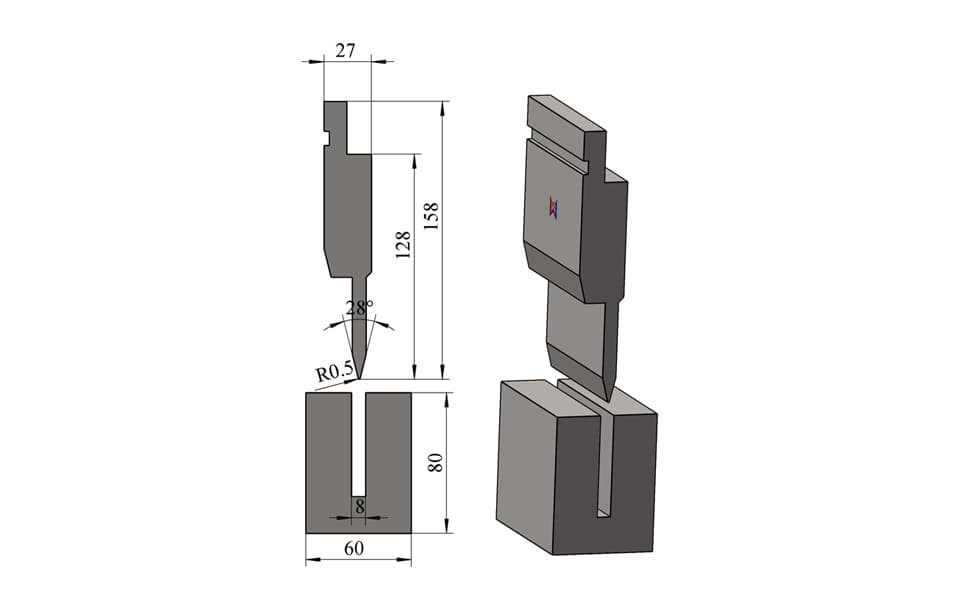
Custom Roller V-Die for Low-Marking Sheet Metal Bending
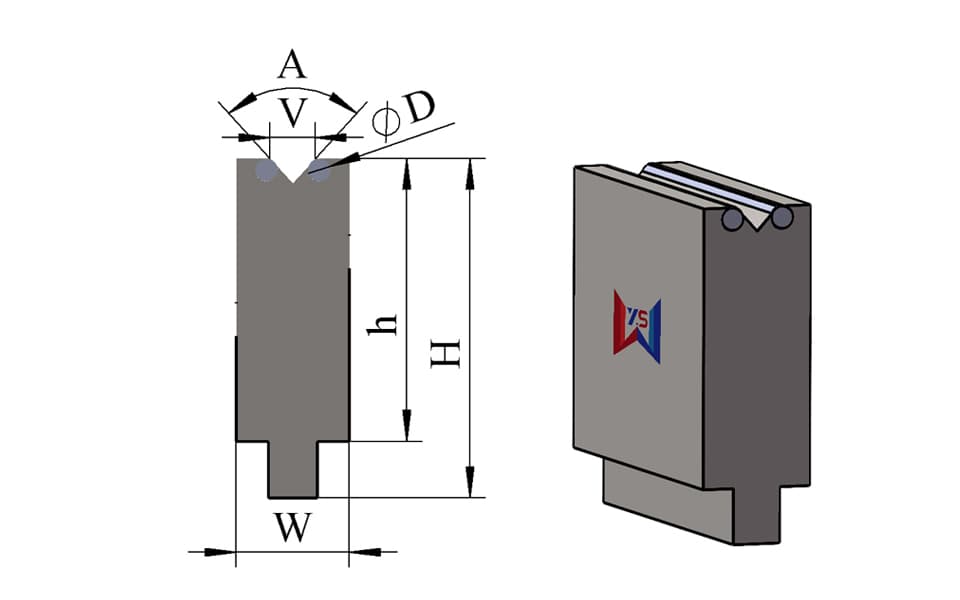
A custom roller V-die for press brake bending designed to reduce surface marking, friction and scratching during sheet metal forming. Instead of allowing the workpiece to slide directly over conventional fixed die shoulders, the tooling uses rotating rollers at the die opening. As the sheet moves during bending, the rollers rotate with the material, reducing sliding friction and helping protect sensitive sheet surfaces. The tooling shown has a maximum rated load capacity of 80 ton/m and uses a plug-in lower die mounting structure. All key dimensions—including V-opening, die angle, roller diameter, tooling height, width and mounting interface—can be customized according to the workpiece and press brake. Alternative lower-die structures such as T-type, multi-V and other custom mounting configurations are also available.
Please add the quotation and send it to us and get in touch with us immediately
- Global service 24/7
- Lowest price for all products
- Best quality with Production Process
- After-Sale Warranty
- Technical Support
Description
Custom Roller V-Die for Low-Marking Press Brake Bending
This roller V-die is a special press brake lower die designed to reduce surface damage during sheet metal bending.
In conventional V-die bending, the sheet moves across the shoulders of the lower die as the punch enters the V-opening. This sliding contact can create friction marks, scratches or visible die lines, especially on stainless steel, aluminum, pre-finished sheet and other appearance-sensitive materials.
The roller die uses rotating cylindrical rollers positioned at the die shoulders.
During bending, the rollers rotate as the sheet moves toward the V-opening. This changes much of the contact from sliding friction to rolling contact, helping reduce drag and minimizing visible surface marking.
The result is a practical bending solution for applications where surface appearance is important and traditional fixed V-dies may leave unacceptable marks.
Working Principle
During press brake bending, the punch forces the sheet downward into the V-opening.
With a conventional fixed lower die, the material slides across the die shoulders as the bend develops.
With this roller V-die, the sheet contacts the rotating rollers instead.
As the workpiece moves during bending, the rollers rotate with the sheet, reducing relative sliding at the contact points.
This rolling action can help:
- Reduce friction
- Reduce scratching
- Minimize die marks
- Protect finished sheet surfaces
- Improve surface appearance after bending
The degree of marking reduction depends on material type, surface condition, tooling geometry, roller condition and bending parameters.
Key Features
Rotating Roller Contact
The die shoulders use rotating rollers instead of conventional fixed contact surfaces.
Reduced Sliding Friction
Rolling contact reduces the amount of direct sliding between the sheet and lower die.
Low-Marking Bending
The tooling can significantly reduce conventional die marks on appearance-sensitive sheet metal.
Suitable for Surface-Sensitive Materials
A useful option for stainless steel, aluminum, coated sheet and other parts where surface finish is important.
80 ton/m Rated Load
Maximum rated tooling load:
80 ton/m
Fully Customizable Dimensions
The illustrated drawing intentionally does not specify fixed dimensions because the tooling can be manufactured according to the customer's application.
Custom Lower Die Mounting
The shown version uses a plug-in lower die structure, while other mounting and base styles can also be manufactured.
Technical Specifications
| Parameter | Specification |
|---|---|
| Tool Type | Roller V-Die / Roller Press Brake Die |
| Main Function | Low-Marking Sheet Metal Bending |
| Contact Structure | Rotating Rollers |
| Maximum Rated Load | 80 ton/m |
| V Opening | Customizable |
| Die Angle | Customizable |
| Roller Diameter | Customizable |
| Overall Height H | Customizable |
| Working Height h | Customizable |
| Tooling Width W | Customizable |
| Lower Die Mounting | Plug-In Structure Shown |
| Alternative Mounting | T-Type, Multi-V and Custom Structures |
| Tooling Length | Customizable |
| Segmentation | Available |
| Compatible Press Brake Systems | Customizable |
Reduced Marking and Surface Protection
One of the main advantages of roller press brake tooling is its ability to reduce traditional marking caused by fixed V-die shoulders.
Specialist roller-style press brake dies are used in the industry specifically because rotating support surfaces can reduce marking and improve bending performance. For example, Rolla-V describes “minimal marking” as one of the primary advantages of its rotating-insert tooling and also highlights applications involving sensitive geometries and difficult sheet shapes.
This makes roller tooling particularly useful when bending:
- Brushed stainless steel
- Polished stainless steel
- Aluminum sheet
- Pre-painted sheet
- Coated steel
- Decorative panels
- Visible exterior sheet metal parts
The tooling does not guarantee completely mark-free bending in every application, because surface results still depend on material, tooling condition and forming parameters.
Advantages of Roller V-Die Tooling
Reduced Surface Scratching
The rotating rollers reduce sliding contact at the lower die shoulders.
Lower Friction During Forming
Less sliding friction can improve material movement during the bending process.
Better Surface Appearance
Roller tooling is particularly useful when visible die marks are unacceptable or need to be minimized.
Flexible Die Geometry
V-opening, angle and roller size can be adjusted to different bending requirements.
Custom Mounting Options
The lower tooling interface can be manufactured according to different press brake tables and die holders.
Suitable for Special Bending Applications
Roller-type tooling can also be useful in applications involving short flanges, holes near bend lines or difficult part geometries, depending on the specific roller-die design. Specialist Rolla-V tooling, for example, promotes reduced marking, short-flange capability and reduced deformation near holes or cut-outs as key benefits of its rotating-insert concept.
Custom V Opening, Angle and Roller Diameter
There is no single standard dimension that is suitable for every roller die application.
The following parameters can be designed according to the workpiece:
- V-opening
- Die angle
- Roller diameter
- Roller center distance
- Overall tooling height
- Working height
- Tooling body width
- Lower die mounting profile
- Tooling length
- Segment length
- Maximum load requirement
The correct geometry depends on sheet thickness, material grade, bend radius, flange dimensions and press brake configuration.
Plug-In Lower Die Structure
The tooling shown in the drawing uses a plug-in lower die mounting structure.
This is only one available mounting configuration.
Depending on the customer's machine and lower die holder, we can manufacture different structures such as:
- Plug-In Type
- T-Type
- Multi-V Type
- Wide-Base Type
- Single-V Type
- Custom Tang Profiles
- Custom Base Interfaces
The mounting structure can be manufactured from customer drawings, existing tooling samples or press brake specifications.
Typical Applications
This roller V-die is suitable for bending applications where surface quality is an important requirement, including:
- Stainless steel cabinets
- Electrical enclosures
- Control panels
- Elevator panels
- Appliance panels
- Architectural sheet metal
- Decorative stainless steel parts
- Aluminum panels
- Machine covers
- Equipment housings
- Pre-painted sheet components
- High-appearance sheet metal products
Suitable Materials
Roller V-dies can be designed for a wide variety of sheet materials, including:
- Stainless steel
- Mild steel
- Aluminum
- Galvanized steel
- Pre-painted sheet
- Coated metal
- Decorative sheet materials
Tool selection should be based on material thickness, strength, surface condition and required bend geometry.
Custom Roller Press Brake Tooling
The Tool Shown Is Only One Example
The drawing shown on this page represents one example of a roller V-die with a plug-in lower mounting structure.
It does not represent the full range of roller dies that we can manufacture.
We can customize:
- V-opening
- Die angle
- Roller diameter
- Roller material
- Roller spacing
- Overall height
- Tool width
- Working height
- Lower die structure
- Mounting interface
- Tool length
- Segmentation
- Load capacity
- Tooling material
- Heat treatment
- Surface treatment
Special versions can be designed according to customer part drawings and actual bending conditions.
Compatible Press Brake Tooling Systems
The lower die mounting interface can be customized for different press brake and tooling systems.
Available configurations include:
AMADA Type
TRUMPF Type
WILA Type
LVD Type
Bystronic Type
and other press brake tooling systems.
Special mounting interfaces can also be manufactured according to customer drawings, existing tooling samples or machine specifications.
Specialist roller tooling suppliers also offer multiple tang and clamping structures for different machine systems, which supports the practical importance of matching this type of die to the customer's lower tooling interface.
Custom Tooling Design Service
For special bending applications, customers can provide:
- Finished part drawing
- Sheet thickness
- Material grade
- Surface finish requirement
- Required bend angle
- Inside bend radius
- Flange dimensions
- Press brake model
- Lower die holder structure
- Available machine tonnage
Our engineering team can evaluate the application and design an appropriate custom roller press brake tooling solution.
Important design factors include:
- V-opening
- Roller diameter
- Roller position
- Material thickness
- Material tensile strength
- Required bend radius
- Minimum flange
- Surface marking requirements
- Tooling load
- Mounting interface
- Workpiece interference
Roller V-Die vs. Conventional V-Die
| Feature | Roller V-Die | Conventional Fixed V-Die |
|---|---|---|
| Sheet Contact | Rotating rollers | Fixed die shoulders |
| Contact Movement | Mainly rolling | Mainly sliding |
| Surface Marking | Reduced | More likely |
| Friction | Lower | Higher |
| Surface-Sensitive Applications | Particularly suitable | May require protection film |
| Tool Complexity | Higher | Simpler |
| Custom Roller Geometry | Available | Not applicable |
| Custom Mounting | Available | Available |
Related Low-Marking Bending Solutions
Depending on the sheet material and required surface quality, we can provide different low-marking bending solutions, including:
- Roller V-Dies
- Low-Marking Press Brake Dies
- Anti-Marking Film
- Polyurethane Bending Solutions
- Custom Radius Tooling
- Special Press Brake Lower Dies
- Custom Forming Tooling